
Most business books are terrible. They are collections of vague life advice, dressed up as frameworks, with graphs stolen from McKinsey. The few that contain real research are written with all the excitement of a forklift safety manual. In almost every case, you’re better off watching a nine-minute YouTube summary made by a 19-year-old with Canva Pro.
Yet millions of copies get sold each year, mostly to sit on somebody’s bookshelf to try to convey to people they are literate. These books could be empty for all these people know, since most remain unopened. In many cases, they are better off that way.
I’ve had to suffer the indignity of taking the time to read them to confirm this was the case. I could have used some of that time instead re-organizing an elaborate book shelf, to convey status during Zoom meetings. I can’t help it though, I like to read.
Last month I released the books I read in 2025, the ratings are good, largely because I’ve started abandoning bad books early, and I don’t include them on my lists. By chance I happened upon a book in a London book store that made this excavation worthwhile.
Roald Dahl is known for Willy Wonka, chocolate factories, and children’s stories. Near the end of his career, he decided to write a novel about erections and artificial insemination. What was meant to be humorous fiction turned out to contain more genuine business insight than most business books or articles (even on Substack). Dahl’s protagonist, Oswald Cornelius understood incentives, product-market fit, pricing power, and strategy better than most venture backed founders today.
Keep reading if you want to learn these business insights from a fiction legend !
But first, make sure to hit the Subscribe button to join 1,000+ other Subscribers that get Serviceable Insights delivered directly to their inbox each week.
If this week’s article does not interest you, please check out some other recent ones:


Who is Roald Dahl?
If you don’t think know who Roald Dahl is, you are wrong. If you can read in English, it’s hard to believe you are not familiar with some of his works. Willy Wonka and The Chocolate Factory was not a documentary, it came from Dahl’s imagination. As did The Gremlins, The Fantastic Mr. Fox, The Wonderful Story of Henry Sugar and many more.
Even if you haven’t read his original works, many of his stories have made it to the screen. Wes Anderson alone has adapted several of them. Dahl’s style is dark but mischievous, grotesque and imaginative, yet still sharply observant. His ability to create worlds that mix the fantastic and the realistic, filled with characters you can simultaneously love and hate, is unique. His children’s stories entertain kids and quietly humour parents.
Born in 1916 in Wales to a family of Norwegian immigrants, he lost his father young, but there was enough money left for Roald to attend reputable British boarding schools. He was a fighter pilot in WWII, spending time in different parts of Africa, Egypt, and Greece. He then became a diplomat, living in Washington alongside other British literary figures such as Ian Fleming (of James Bond fame) and David Ogilvy, helping promote British interests and counter the America First mentality of the time.
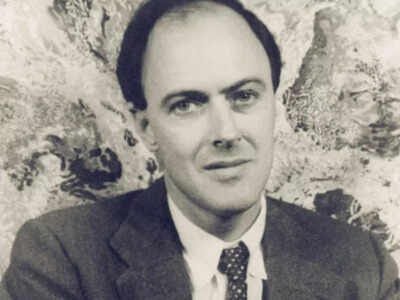
He began writing seriously during WWII, during his time as a pilot, with “A Piece of Cake” (originally titled Shot Down Over Libya) published in the newspaper in 1942. He didn’t really reach major notoriety in the 1960s with the release of James and The Giant Peach and Charlie and The Chocolate Factory. He was a prolific writer, publishing 50 books and nearly 100 short stories up until his death in 1990.
Despite his prowess as a writer, his legacy took a hit because he was a raging antisemite (and not in a fun way). Over his life time he gradually went from being critical of specific Israeli policies, to hating all Jews. He wasn’t discreet about it either. Looking at some of his quotes from magazine articles, you would have a difficult time discerning if it was Dahl or Kanye West during his latest bi-polar episode. At least that was in the past and jews no longer need to worry about discrimination1.
Beyond his problematic views on Jews, his frequent lack of seriousness, bordering on immature behaviour, cost him other honors, including knighthood. This robbed him of acclaim his incredible talent deserved. Nonetheless, he remains a legendary fiction author with vast range and life experience, which allowed him to write on an extraordinary variety of topics, including those explored in My Uncle Oswald.
Short Book Summary
Spoiler Alert. If you plan to read the book you can skip to the next section which only contains light spoilers.
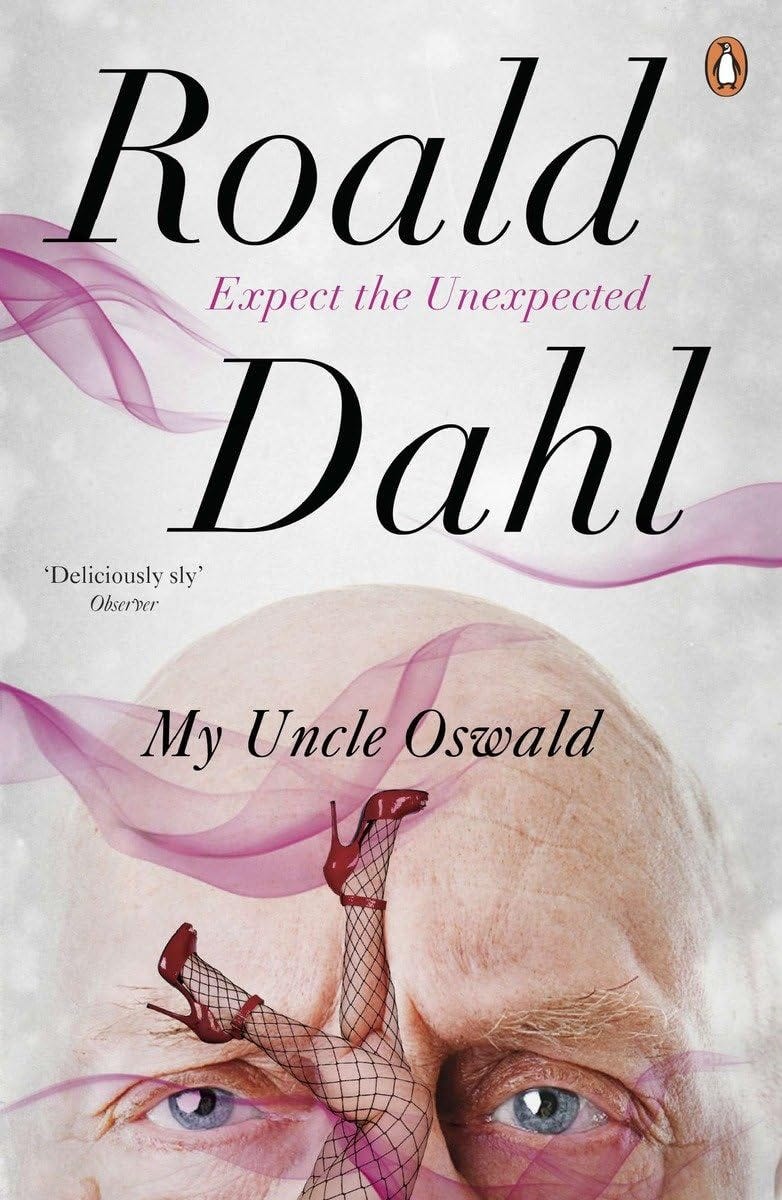
My Uncle Oswald is presented as Roald Dahl recounting the journal of his fictional uncle, Oswald Hendryks Cornelius. Oswald describes his adventures galivanting across Europe, meeting women, and building a business empire predicated on erections. Yes, you read that correctly. Young Oswald learned early what the modern pharmaceutical industry would later discover: there are billions of dollars to be earned in supporting male reproductive health (and women benefit too).
As a 17-year-old enjoying a gap year in Paris, a chance encounter with an acquaintance of his ambassador father cuts Oswald into a secret. The secret was that if a certain Sudanese insect was consumed, the consumer would be overcome with lust and experience substantial growth in the loin region.
A curious and enterprising lad, Oswald immediately went to Sudan to track down the insect. He procured a major quantity of the powder and brought it back to Paris. After getting it into pill form and testing its potency, he shared samples with a few diplomats. Needless to say, it was a smashing success.
These diplomats were banging down Oswald’s door for more and happy to pay any price. Word spread quickly in their circles, allowing Oswald to amass a sizeable fortune. When his gap year ended, he went to Cambridge, but his education and fun were interrupted by World War I. When it ended, he returned to resume his studies. Before he could continue with his pill business, his professor let him in on another secret: a scientific discovery not yet public. Artificial insemination. His professor planned to use it to help his brother breed good horses. Oswald had far more ambitious breeding plans.
He believed that wealthy women would pay enormous sums for the sperm of world-famous men such as artists, scientists, royalty, and business leaders. The appeal was the hope that their children might inherit the talent or prestige of these men.
His professor was skeptical. With the help of his partner, Yasmin Howcomely, Oswald created a scheme to obtain semen from celebrated men across Europe. Yasmin seduced the targets, Oswald collected the results, and the professor processed the material for future customers. The operation grew quickly, and the team prepared to expand to the United States.
Yet the travel and hard work involved in extracting the semen began to take a toll on Oswald’s partner. She demanded a month-long break before setting off for America. When the month was up, Oswald returned to discover she had stolen the sperm and ran off with the professor, cutting him out of the deal.
Oswald realized he had been had but decided to revert to selling the erection pills, which once again helped him amass a major fortune.
Oswald Cornelius: Europe’s Warren Buffet?
“Every great business is built around a secret that’s hidden from the outside.” — Peter Thiel
Oswald did all the right things for someone looking to start a successful venture. After learning of a secret hidden from the world and understanding how valuable this discovery could be, he did not hesitate. He immediately headed to Sudan to seek it out for himself.
He believed that a product capable of producing such intense lust would be valuable to many men. He first tested it on himself, then validated demand with a small subset of his target market: rich, middle-aged men. The fact that they were banging down his door, completely price insensitive, and telling others about it validated Oswald’s hypothesis. He had found Product Market Fit.
The product was flying off the shelf at any price point. Without advertising, he sold it at outrageous margins, and every buyer tried to purchase as much as possible. He had virtually no overhead and was operating at close to a 90 percent profit margin.
While he never scaled his small venture into a large enterprise, he did not need to. With profits that high, it would not take him long to amass a large fortune. Since everything was done discreetly, he could avoid declaring taxes. If he continued on this trajectory for two or three years, he could have reached a level of wealth that would allow him to live off the interest alone. He was the ultimate solopreneur.
Yet instead of milking this for what it was worth and scaling up the operation, he tried to pivot to a potentially more lucrative endeavor: famous person semen. However, unlike with his first venture, Oswald invested heavily up front before commercializing anything. Galivanting across Europe, staying at the Ritz Carlton, and eating at Michelin-level restaurants for weeks at a time gets expensive. If you do not believe me, try it yourself, just don’t ask me for reimbursement. This is without factoring in storage costs and other operational overhead.
While Oswald was confident there was a market for famous person sperm, he did nothing to validate it or prove willingness to pay. He did all this work without speaking to any customers. For all he knew, the price they would be willing to pay might not justify the effort or investment. In essence, he abandoned a proven and lucrative boner-pill business to pursue a risky and unproven sperm venture long before he needed to.
There was no competition, growth showed no signs of slowing, and he had not come close to saturating the market. Oswald owned a money-printing machine with minimal overhead but temporarily abandoned it for a riskier venture that had similar upside but perhaps a deeper moat. In exchange for this moat, he had to rely on partners, which split the profits, and they eventually decided they did not need him at all. He never had this issue with the pill business. He could run it himself or at least without equal equity partners.
This is the conclusion he eventually reached. Scaling up the pill business made him a very wealthy man, and he did not need to sleep with any kings or poets. Some would call that a plus. Although Oswald did not get to profit from the semen business, his partners did, and he still managed to amass his own fortune. It appears that things worked out best for everyone. It was a perfect capitalist outcome. A group of upper-middle-class bourgeois types extracted money from the very wealthy and became the very wealthy themselves. Roald Dahl understood this and perfectly captured this dynamic in a laugh out loud story, teaching the young and old how to amass a fortune, and have fun while doing it.
Thank you for reading. If you liked this article please Subscribe below. I publish articles on a wide range of topics from business, books, current events or anything on my mind.
In case you were uncertain that was sarcasm.
this was a nostalgic read! just made me wonder if Roald Dahl actually envisioned eugenics in his time