

"A mind stretched by a new experience can never go back to its old dimensions."
— Oliver Wendell Holmes Jr.
Bruce Lee doesn’t fear the man who has practiced 10,000 different kicks once but one who has practiced one kick 10,000 times. This sounds sensible. Given that Lee has gotten into many more fights than I have he’s probably right. As a spectator how boring would it be go to a UFC event to see a fighter with only one move? Variety and contrast make life interesting and worth living. Trust me, I’ve lived the counter factual. Near the end of my university exchange, with funds running low I had to survive on lentils alone for a week. Wasn’t fun.
Specialists are important and have their place, but too often these people focus on their craft to the exclusion of anything else, creating a society of non-playable-characters (NPC1s) with no distinctive interests or hobbies outside of their domain. This is why we don’t like career politicians and most people can barely name a CEO; for them all they see is a rotating door of nameless, faceless empty suit/pant suits2. While a specialist will know more about their domain than a non-specialist, knowledge does not always translate into effectiveness, especially in endeavours featuring other humans. Highly successful people can often accomplish more outside their original domain than expert specialists.
Case in point: Benjamin Franklin. Franklin was successful as a newspaper editor, tradesmen, entrepreneur, politician, diplomat, scientist, inventor and author. Oh and he also played a major role in the American revolution and drafting the Declaration of Independence and US constitution. Not only did he accomplish all of this, he managed to have more fun than anybody else.
This article will summarize why varied interest and experiences are a super power, explain how Benjamin Franklin represented the ethos of America, why we need more people like him and which modern figures are most like Ben.
If this week’s article does not interest you, please check out some other recent ones:


When 10,000 Kicks 1 Time > 1 Kick 10,000 Times
If you work in a field that cannot be improved with creativity or unique perspectives, then trying new things won’t make you better at your job. This would apply if you work on a conveyer belt, as a crash test dummy or the person that writes Jason Staham’s film roles.
Otherwise if your objective is to create excess value (alpha) in your domain, you should pursue many interest or hobbies outside your profession. Not only can these other activities give you new ideas, they make you more interesting. As knowledge is increasingly easy to access, you need to do more than just share information; you need to offer wisdom.
What is wisdom? According to Chat GPT it’s the ability to make sound decisions and judgments based on knowledge, experience, insight, and an understanding of life's complexities. Based on that, the more varied situations you put yourself in, the wider pool of experience you’ll be able to draw from, allowing you to make unique connections. If you can’t think or do something new or different, what replacement value do you offer above an AI chatbot?
This is why in the future if you want to add value, you need to decide which end of the barbell you want to occupy: Be the most knowledgeable person within your respective domain or have average knowledge in many domains? If you don’t fall squarely in either bucket, your job is at risk of getting replaced by AI.

This assumes you are in a position where skills or knowledge can lead to better performance. If your role is based on appointment, like politics, you can still hope to coast by with charisma, nepotism or relying on favours/begging the right people for the position. People will need to fill these roles but ideally, they should be made up of people who already experienced successes in other domains. A bit like our favourite founding father Benjamin Franklin.
Benjamin Franklin’s Importance to America
1) Early Beginnings & Tradesmen
Benjamin Franklin ended up in America because of intolerance: religious and economic. His father, Josiah Franklin was a silk dyer at a time when there was insufficient demand. In 17th century England you had to do long apprenticeships and get permission to take on a trade. Josiah had a large family to support and couldn’t afford to live without a paycheck while starting a new apprenticeship, so he moved to Boston to sell candles. Nobody knew it at the time but this just cost England one of the brightest minds of the 18th century. Their loss was America and the world’s gain.
Despite early signs of intellect, his father decided against sending him to Harvard because of a combination of the cost and believing the clergy would not be the best place for Benjamin. Ben instead went into a trade: printing. He started working for his brother as an apprentice. With his wit and incredible work ethic, he quickly learnt the trade and won the respect of his colleagues. Like many printers, his brother James decide to also found a newspaper, The New England Courant.

James wouldn’t publish his brother’s stories therefore Benjamin began submitting anonymous stories pretending to be a widowed woman by the name of “Silence Dogood”. With nothing but his imagination, Franklin did a good enough job convincing people that he was a middle-aged woman living in on the country side, despite never stepping foot outside of Boston. Anon Twitter trolls were different in those days. After realizing there wasn’t going to be enough opportunity working for his brother, he ran away, ending up in Philadelphia, working in another print shop before eventually starting his own (Notice a trend in this family)?
BF’s upbringing differed from many of the founding fathers since he was born middle class while most were born wealthy such as Washington, Jefferson and Hancock. Franklin’s held hard work and talent in greater esteem more than the social class somebody was born into. He was quite against anything that would resemble elitism, believing strongly that it was preferrable to have a society with more social mobility. This was not a view held by many of the founding fathers and politicians at the time. While he was not alone in believing this, Franklin ardent belief was always among his most important tenants while drafting and debating the constitution.
2) Entrepreneur, Author & Community Organizer
Franklin eventually opened his own print shop and along with it a newspaper the Pennsylvania Gazette, which grew to become among the most read in the colonies. He also printed books, including one he wrote Poor Richard’s Almanac. Poor Richard’s Almanac was among the best selling books at the time, selling about 10,000 copies per year (when there was only about 1 million people living in America). It included all kinds of helpful advice & maxims. The book sales were lucrative but his wealth largely came from a franchise model that he created for his business, creating possibly the first countrywide media conglomerate in America at the time.

If you aren’t impressed by that, he also founded several societies, the first public library in the country, first volunteer fire department, the University of Pennsylvania and contributed to many civic improvements to the city of Philadelphia. He eventually decided that running a nationwide media company no matter how lucrative, was taking up too much of his time so at the age of 42 he retired. Franklin sold the business to his partner, giving him an annual royalty/dividend and retired from business. Now with a steady source of income, and time on his hands, he had the conditions to make the leap from local hero to international icon.
3) Amateur Scientist, Inventor & Diplomat
“There never was a good war or a bad peace!”
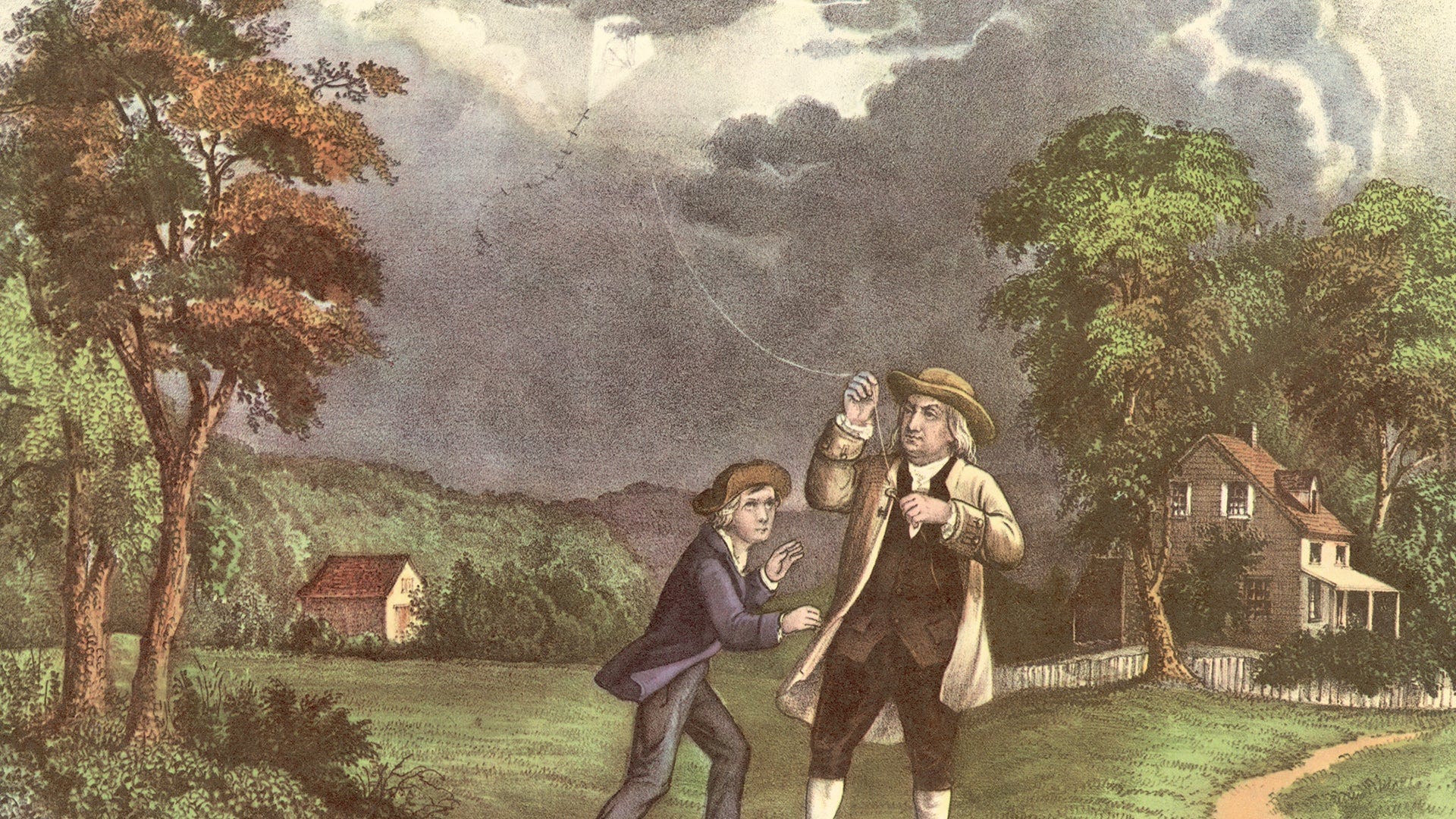
Despite not going to university, Ben Franklin was an avid reader and deeply scientific in his thinking. Unlike many academics, however, he didn’t care much for theory; his focus was on the practical applications of science. He constantly conducted experiments and sought explanations for why things happened. This practical approach made him among the most important figures of the enlightenment era. He demonstrated electricity was a single fluid that could move between objects and that lightning was just a large-scale manifestation of this.
Before conducting the famous kite experiment, he had already submitted his theory to the science authority in England. At the behest of the French monarchy, it was translated into French; they thought it was the coolest thing ever. Eager to prove it, they started throwing rods over different buildings. When lightning struck, they proved Franklin’s theory. This happened months before Franklin’s kite experiment, but due to slow mail delivery, he only learned about their success afterward.
The discovery made him an overnight sensation in Europe, making him the first American international icon and American European intellectuals considered worth listening to. This newfound celebrity, made him a welcome dinner guest across the old continent. He had no shortage of topics to discuss. When not experimenting or making scientific observations, he invented items like the Franklin stove, the flexible catheter, and bifocal glasses. The man had Daniel Day-Lewis range.
Franklin’s fame granted him a stature that commanded respect. Despite France’s initial reluctance to support American independence, Franklin’s charm and intellect convinced them otherwise. When Franklin arrived in France, crowds lined the streets as if he were Bono, Kanye, or Taylor Swift. This admiration wasn’t limited to commoners; his spectacles and fur cap even influenced aristocratic fashion. Franklin regularly met with King Louis XVI and other key figures, gradually persuading them to provide gunpowder, troops, naval support, and funds. France became the first nation to recognize the United States as an independent country. Without French support, America would not have won the war—a remarkable achievement for a nation France initially hesitated to aid.
Franklin’s diplomatic style set him apart from his contemporaries. While John Adams and others preferred aggressive ultimatums based on realism, Franklin understood that approach wouldn’t work with the French. Instead, he adopted a patient, steady strategy that appealed to both realism and idealism. His understanding of French culture and his Enlightenment ideals made him the more effective negotiator. The other American diplomats, often inefficient and overly aggressive, only pushed the French away, leaving Franklin as their preferred contact.

If Franklin hadn’t led these negotiations, French support might have been minimal, or the Americans might have made concessions that would have hindered the creation of an independent republic. Franklin, while naturally conciliatory, knew when to stand firm and when to compromise. This wisdom was evident in his dealings with the French, the British, and even during debates over the U.S. Constitution. Franklin believed that refusing to compromise showed a lack of intelligence, as it reflected an unwillingness to admit the possibility of being wrong or to adapt when circumstances changed. He often accepted imperfect solutions that advanced progress, knowing he could revisit unresolved issues later. Preferring the good over the perfect. With this approach, assuming you are dealing with intellectually honest individuals, you can always return to the table and say, “We tried it this way; it didn’t work. Now let’s try another approach.”
Too often in politics or business, people refuse to compromise or support measures introduced by opposing parties, viewing such actions as weaknesses rather than strengths. The sign of great thinkers, is they understand the limits of their knowledge. Check out the Dunning-Kruger effect. The DK effect was not published during Franklin’s time but he was skeptical of people or institutions who believed they could not be wrong, whether this be Monarchs or Religions.

Conclusion
Benjamin Franklin’s life reminds us that cultivating diverse skills and pursuing varied interests, can give us a unique ability to solve real-world problems. Specialists will always have their place, but the ability to bridge domains, think creatively, and adapt to new challenges is what makes someone truly irreplaceable. As automation and AI reshape the job market, the Franklin ethos of curiosity, adaptability, and breadth of experience becomes even more valuable.
While we’ve explored modern figures with impressive achievements, none come close to Franklin’s unparalleled success and impact on the world. His contributions as a scientist, inventor, statesman, and philosopher shaped not just the United States, but the very Enlightenment ideals that continue to guide humanity. Franklin wasn’t just great because he excelled in many areas, he was great because he sought to improve himself and the world around him.
Whether you aim to master one kick or explore 10,000, the key is to maintain a mindset that values growth, experimentation, and wisdom. The future belongs to those who can connect the dots across disciplines, inspire others, and lead with both idealism and pragmatism. So, whether you’re in science, business, art, or diplomacy, ask yourself: how can you think and act more like Franklin? Because in a world increasingly dominated by AI and specialists, the ultimate differentiator is a mind that dares to wander.
I hope you enjoyed today’s article. Please Subscribe or Share Some Feedback in the Comments
NPCs originate from video games, where the player interacts with game characters running on a controlled loop by the game. They generally repeating the same message and can’t think for themselves.
The 2016 Edelman Trust Barometer reported almost half of surveyed individuals couldn’t name one CEO. Sample size was small and worldwide so I think those numbers aren’t that reflective but if it’s on the internet, it must be true. Fortune article.
Maximizing interest in life is valuable in itself. Not everyone can be a Ben Franklin, but it would be very boring if no one was.