

Given a choice between being born with a million dollars or as a Rothschild, Lannister or Coppola but with no assets to inherit, which would you take?
The initial instinct is to take the money. With compound interest that will be worth tens of millions by your thirties guaranteeing a level of security few can enjoy. However, this is short sighted. If your goal is to build something enduring, the advantages of intangible assets compound faster than what’s in your bank account.
There are endless personal finance books teaching how to build wealth. Whether they are about how to live frugally, why to invest in real estate, buy ETFs etc. they only talk about how to accumulate tangible assets. Tangible assets are important but they are limited because they can only help you access things money can buy.
How would you feel about one of your children marrying somebody with the surname Hitler? Even if this young Hitler was very wealthy, it would be normal to have concerns with the association. They would need a lot of money to offset the baggage their name brings. For many, under no circumstances would they consort or do business with somebody like this. Money can't buy everything.
Your reputation is what people think of you before you enter a room. If they are primed to like you, it’s easier for you to get along. If they’ve decided you aren’t worthy, you’ll face an uphill battle. The better your reputation, the easier your life will be.
Every promise you keep, person you help and difficult situation you handle enhances the way you are perceived. Every broken commitment, act of dishonesty or bad energy you bring, detracts. If your good deeds outnumber your negative interactions, you will create goodwill. Goodwill, a strong work ethic, talent and experience are all examples of intangible assets. They don’t have a financial value but they are key determinants to success.
People with goodwill have more supporters than detractors. This increases the chances people will want you to win and this extends to the people around you. They too are impacted by your reputation. Have you ever gotten preferential treatment just by saying you were a friend of so and so, or related to such and such? Have you ever had to answer for somebody else’s crimes because of your association?
Your circle is critical to your success. If you hang around bad actors, their stink will get onto you. If the people around you have goodwill, it will extend to you. At a minimum, you should never do anything that will impair your groups reputation, to succeed everybody needs to enhance it.
Groups that could maintain power for many generations could only do so because they understood the value of goodwill and other intangibles are more durable than money. The Rothschilds didn’t become a premier merchant bank because they offered the best prices. They became indispensable to governments, crowns and key corporations, by being consistently reliable. Even when something seemingly impossible was needed. Whether that was raising millions in uncertain conditions or getting gold past naval blockades. Their empire ran on trust, which inspired a level of loyalty an upstart bank with more capital could not quickly replicate.
“It takes 20 years to build a reputation and five minutes to ruin it.” — Warren Buffett
The more somebody has come through, the more embedded the belief that they will always deliver becomes. This makes them hard to displace and affords them the benefit of the doubt when they can’t. This is why being born a Rothschild or into one of these families comes with advantages that extend far beyond money.
The surname carries with it generations of goodwill, and many potential supporters. This assumes each successive generation can improve or at least maintain the reputation they inherited. Otherwise it atrophies, negating advantages for their offspring. It should be easy but few wealthy families can maintain their fortunes beyond three generations1. This perceived blessing can be just as much of a curse.
If each successive generation is less like the person who made the family noteworthy, the intangible assets will gradually get impaired, which will manifest in the decline of the tangible assets too. Cornelius Vanderbilt had more money than the US treasury, within a few generations, his descendants squandered that fortune. They inherited the financial security without the hunger, drive or business acumen and look what happened. This is a familiar tale.
In Game of Thrones Tywin Lannister understands the value of intangible assets, but unfortunately none of his children do. They believe gold is the answer to any problem but fail to realize they benefit more from the belief “A Lannister Always Pays Their Debts”. They think they will always be the richest so they don’t do anything to ensure future generations will be afforded the same privilege. Succession depicts this as well. Logan Roy built an empire, but none of his children appear equipped to continue the legacy. The next generation were born with all the trappings of wealth but without his killer instinct. They can’t replace their father.

Tywin and Logan were brutal, ruthless and willing to do things that made them unpopular in the short term to benefit their families in the long term. This has nothing to do with money. Future generations benefitted from their actions, but failed to understand if they didn’t make similar maneuvers, their family name would gradually fade to irrelevance.
People use the term “nepo baby” to dismiss the success or discredit people coming from prominent families. If they aren’t actively trying to enhance their families reputation, they are contributing to its decline. If somebody is born with certain advantages why shouldn’t they use it? Are they expected to nerf themselves and cosplay as pre-batman angsty Bruce Wayne just to prove they are self-made?

Cobb and his crew successfully convince Robert Fisher of this in Inception by preying on his insecurity. They explicitly say the only way he could fail, is for him to decide he needs to become his own man. Fisher decides to break up his father’s energy monopoly, because he didn’t want his dad to perceive him as a nepo baby.
Being born into a prominent family can create advantages but deliberately refusing to use it does not make the system more fair. It’s just wasting an asset created by a previous generation. Should Shaquille O’Neal have pretended he wasn't a giant and insisted on playing point guard? Perhaps people would have thought it was admirable of him not to exploit his size advantage but he would not have made the NBA. Shaq, the Magic, Lakers and Heat franchises would have been worse off for it.

One of Citadel founder Ken Griffin’s most frequently gifted books is Hardball: Are You Playing to Play or Playing to Win? The book’s central argument is that if you are serious about winning in a competitive field, you must exploit every legitimate advantage at your disposal. Not everyone agrees but what’s the alternative? Self sabotage?
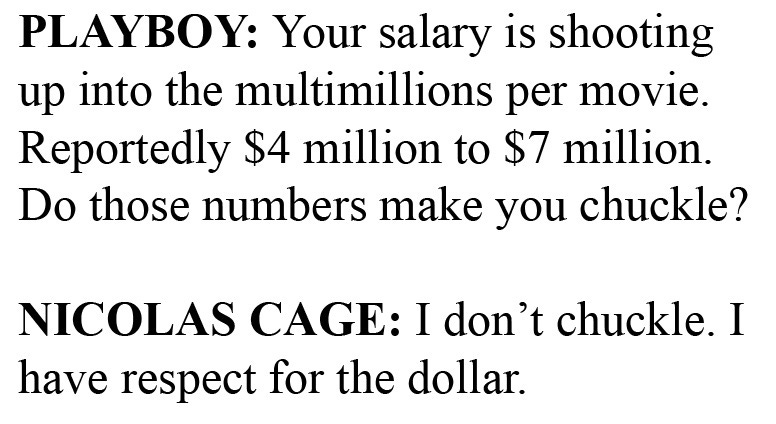
Nicolas Cage, Jason Schwartzman and Sofia Coppola grew up as part of the Coppola family. If they wanted to be self-made, they would have avoided the entertainment industry. Whether casting directors chose them because of their family name is irrelevant. The proximity to a Hollywood legend such as Francis Ford gave them access to an invaluable resource few would ever get. When you are watching a Nick Cage film, it doesn’t matter what family he was born into. The only thing the audience cares about is his performance. Cage isn’t the only person that benefits from his acting talent. So does anyone he works with because he elevates the film.
Would Christopher Nolan’s films be worse if his last name were Coppola? Of course not. Undoubtedly Sofia, Nick Cage and Jason Schwartzman had a leg up because of the goodwill created by Francis, but it’s their talent that made Lost in Translation or Leaving Las Vegas successful. No amount of nepotism will get Schwartzman an Oscar2.
This isn’t a defence of nepotism but an acknowledgment that intangible values that get transferred among friends and family are more valuable than material wealth. Spending time with highly successful people, is more likely to help you be successful long term. Even if it isn’t specific tricks of the trade they pass down, seeing what it takes to be great permits others to follow and build off the examples set for them.

The value doesn’t come from your name, you can hail from any family, the company you keep matters more. I’ve been helped by countless individuals who can’t even pronounce my name. Your reputation is a proxy for the intangibles before somebody has met you. No matter how people initially perceive you, it’s possible to win anyone over by building goodwill. Consistently being reliable and delivering when others can’t, builds trust. It’s this trust that bolsters your reputation, making it increasingly easier for more people to want to like you and help you succeed.
The right combination of intangibles is a greater predictor of success than money. Becoming the strongest version of yourself, has a far more enduring impact on your community. You can’t take tangible assets with you when you die. No matter what inheritance tax a government tries to levy on future generations, the reputation, lessons and goodwill you create during your lifetime and pass to future generations will help elevate individuals for far longer than anything money could buy.
Too much attention is focused on building tangible wealth, when the real value is in the intangibles. That is why the value of money is overrated.
Thank you for reading. If you liked this article please Like, Comment and Subscribe below.
Although this is a commonly cited stat, this particularly study cited here says 70% within two generations and 90% within three generations. That sounds impossibly high. It’s cited on the CFA institute website so it must be right, right?
With due apologies to Jason Schwartzman who did nothing to deserve that stray.
Thanks, Ben. I certainly find that appreciation from people I impacted is far more rewarding than my investment success post retirement. There are a lot of good books addressing the question of how a few families, such as the Rockefellers, have succeeded across many generations.