

It’s a tough week to be a PYPL 0.00%↑ shareholder.
Actually, you can extend that to anyone who bought shares since they became public in 2015. Unless they sold during the peak of the 2021 ZIRP era, PayPal is only up 15%.
If you bought and held the S&P over that same period you would be up over 150%. You don’t need to be Warren Buffet to know those PayPal returns aren’t good.
At the current share price, the market is treating PayPal as a relic. A once promising fintech that lost its edge. PayPal isn’t any fintech company though.
They were one of the most important startups of the internet era. It helped invent peer-to-peer payments, defined online checkout, and launched the careers of Peter Thiel, Elon Musk, David Sacks, Reid Hoffman and countless others.
After being acquired by eBay in 2002, clearly nobody who remained at PayPal ever read Zero to One. Instead of aiming to monopolize the online payment space or become the last fintech company, they practically rolled out the red carpet for Stripe, Shopify, Revolut and countless other competitors to eat their lunch.
PayPal’s decline is fascinating because it wasn’t the result of a single bad decision, but a series of incentives, acquisitions, and optimizations that changed the company’s DNA from an innovative fintech pioneer to a boring but secure checkout tool.
Today’s stock chart is the delayed symptom after 20 years of poor choices. It’s a story exemplifies how innovative companies lose their way. PayPal’s fall was avoidable, but the market might be too early to pronounce the company dead.
Keep reading if you want to learn the fascinating PayPal origin story, why eBay’s acquisition might be the most successful botched acquisition of all time, the current payments landscape and if PYPL 0.00%↑ might be a buy at these prices.
If this week’s article does not interest you, please check out some other recent ones:


PayPal’s Fascinating Origin Story:
PayPal could be considered one of the first consumer fintechs and arguably the most consequential startup of the early 21st century.
Founded by Peter Thiel, Max Levchin and Luke Nosek in 1998, with an initial vision of permitting people to send money over their Palm Pilots, they eventually expanded their ambitions to permit people to send and receive money over the internet. What became known as peer-to-peer (P2P) payments. At the time, the main use case for this was eBay, the online auction site that was exploding in transaction volumes. To remove friction, they embedded Merchant checkout buttons (Pay with PayPal) directly onto eBay seller pages (this payments category is called Merchant checkout).
Considering eBay’s own payment options were subpar, they tolerated PayPal at first. PayPal saw rapid growth, but were burning cash quickly. Not only was fraud a big problem, to convince people to fund their accounts PayPal would give them $20. Their margins were thin, so it would take a while to offset this cost to acquire them. This meant, the faster they grew, the more money they lost. This is a lesson most fintech companies continue to ignore.
PayPal soon discovered they weren’t the only one going after this opportunity. Another startup called X, led by Elon Musk, with more funding, was competing for the share of eBay transaction volume. After a few quarters head to head, Thiel and Musk understood that if this continued, the main benefactor to this would be eBay.
They decided to merge the two companies, creating a formidable group. Initially instead of Thiel or Musk leading the combined entity, they brought on former Intuit CEO Bill Harris. There was a clear culture clash, as the PayPal and X people were mostly young developers, while Harris was more of a big company, sales focused guy.
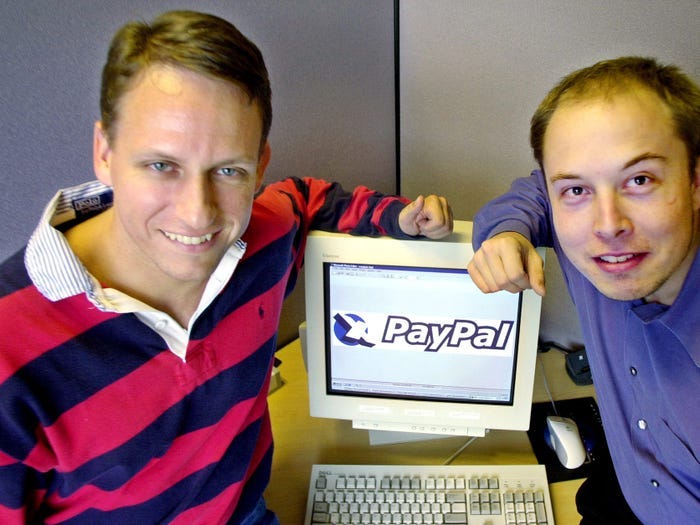
The PayPal and X groups agreed Harris had to go, so Musk replaced him as CEO. Yet this was short lived.
Thiel had stepped away from day to day involvement after the merger but remained a major shareholder and board member. From the PayPal group, Levchin, David Sacks, Reid Hoffman, and several others still played leading roles in the combined entity.
Shortly after Musk replaced Harris as CEO, there were a few seemingly minor but consequential clashes between Musk and the PayPal group. Chief among them were:
Musk wanted to discontinue the PayPal brand in favor of X (which he did to Twitter 20 years later). The PayPal group felt they had built good brand equity and X would be associated with elicit content. This could hurt adoption with people skeptical of providing personal information to a website (remember this was early 2000s).
The other point was technical. PayPal built on Linux and X was built on Microsoft. Levchin and his team didn’t want to rebuild everything in Microsoft which they felt was slow and clunky and would hurt their release velocity. Musk believed they had to migrate to Microsoft because Linux wouldn’t have scaled.
Neither group was willing to relent, so the PayPal group decided to pull off their second corporate coup within a year. They went to the board to fire Elon and replace him with Thiel. The original X employees were not happy with this but they ultimately stayed on. Musk didn’t like it either but he ultimately accepted it and wasn’t disruptive.
Despite this corporate drama, PayPal continued to grow rapidly and put out great products. Thiel knew the IPO window was closing and decided PayPal needed to go public, which they did in February of 2022 at a valuation of $800 million with annualized revenue of $100M. Only 3 years from launch, not bad.
Their time as a public company was short lived; only a few months later eBay acquired them for $1.5 Billion. There were several reasons why they sold but chief among them was the regulatory uncertainty; they were fine with federal regulators but a rogue state attorney general threatened to bring a lawsuit. They decided the risk of dealing with 50 state regulators would hamper their progress to a meaningful degree. Thiel was already a fervent libertarian, this experience did not temper his views.
By this point, it seemed like he was happy to focus on investing, Musk could use the windfall to launch Tesla and SpaceX and the rest of the PayPal mafia went on to launch most of the key companies of the Web 2.0 era. It worked out.

Few decided to stick around post-acquisition, for reasons that explain the problems PayPal find themselves in today.
(If you want to learn more about early PayPal days I suggest reading The PayPal Wars by Eric Jackson or Founders Fund series by Mario Gabriele )
The Most Successful Botched Acquisition
PayPal was the exemplary scrappy, nimble startup. Beyond Thiel and Musk who were in their early 30s, mostly everybody else was in their twenties. What they lacked in experience, they made up for in work ethic and willingness to experiment. The team worked seemingly 24/7, and moved quickly. They had to given how fast they were growing. The atmosphere at PayPal was intense, exciting and in full growth mode.
By 2002, eBay was not this. Launched in 1995 by Pierre Omidyar, they quickly became the dominate online marketplace. In 1998, Omidyar stepped down as as CEO and was replaced by Meg Whitman. Whitman had a successful career as an executive at Proctor & Gamble, Bain & Co, Walt Disney and others before joining eBay when they were a 30 person team doing $4M in revenue.
eBay took a big leap forward under Whitman joined, as they expanded globally and become one of the dominant internet companies. Payments were a constant thorn in their side. PayPal’s emergence helped mitigate some of these issues, but eBay didn’t like ceding control to a 3rd party application. eBay tried to introduce a competitive product, but it was bad.
Seemingly eBay was not very good at building products. Shortly after Whitman took over, the priority shifted to platform uptime and stability, not new features. When they acquired PayPal, they didn’t do so with the goal of expanding internet payments but to retain control of their checkout experience. This was felt by the PayPal team.
Instead of quickly iterating on new product or features, they spent their time in meetings going over Powerpoints about work that needed to be done. eBay had a comparatively corporate feel, which felt slow and suffocating compared to what they were used to. Given the choice between supporting eBays product joining one of their friends at a new startup or beginning their own, most of the PayPal employees opted for one of the latter options. Within a year almost everybody from PayPal had left.
While Whitman and eBay achieved their goal from acquisition, they undervalued a critical part of the company: the employees. They acquired a fintech company but let all the people who understood fintech leave. If the PayPal team had stayed together for even a few more years, they likely would have fenced off the market.
Their departure wasn’t immediately felt. eBay’s core business continued to expand along with the internet but as competitive ecommerce offerings emerged, growth began to slow. Whitman left in 2008, to join HP and was replaced by John Donahoe from Bain. By the time Donahoe took over, the belief was that PayPal was more valuable than just an eBay checkout tool but the product was becoming clunky and legacy like. Before leaving in 2015, under pressure from Carl Icahn, Donahoe spun PayPal out as a public company again, which the stock market deemed as valuable if not more than commerce segment. This along with the Braintree acquisition were likely the most memorable highlights of PayPal under his watch.
This is because post acquisition PayPal didn’t release new products. They made some enhancements to existing features and eventually launched a mobile app, but from a user perspective, the product barely changed from 2002 - 2015. Their eventual marquee product came from Braintree: Venmo founded by Bryan Johnson . Yes the longevity guy. By this time, PayPal was facing stiffer competition across various products from Square, Stripe, Adyen, and even Mastercard & Visa. They had a difficult time building and releasing their own products, forcing them to rely on acquisitions, which they couldn’t integrate into their existing suite.
Former PayPal executive David Marcus, admitted as much in an X post last week. He felt they were quietly starting turning things around between 2012-2014, with the Venmo product being a huge boon for the company. However, after he left, PayPal replaced him with Dan Shulman, who he called a financial operator,. Shulman presided over a number of costly product decisions that would hurt them dearly years later. Basically, they prioritized payment volume over margin or product differentiation at a time where many competitors were innovating.
“The common thread through all of this is incentive design. Once PayPal became independent, short/medium-term predictability beat long-term vision and ambition. Stock performance mattered more than platform risk and network opportunity. Financial optimization replaced product conviction.” —
David Marcus, February 3rd 2026
Despite these struggles, when PayPal went public again in 2015, they did so at a $50B valuation, >30X what they acquired it for 13 years earlier. By this point PayPal was doing $9B in annual revenues, all without meaningfully changing the product in over a decade.
The eBay acquisition was great for the tech ecosystem because of what the PayPal mafia did after leaving, but eBay missed out on the opportunity to dominate the fintech landscape. The combined market cap of the companies started by former PayPal employees exceeds $3 trillion dollars, while eBay’s own core business peaked around 2010.
Fortunately for eBay, PayPal could still grow and command a sizeable valuation in the public markets, reaching a peak share price of $308 for a market cap of $360B in 2021 when fintech companies were commanding premium multiples.
Since then the stock is down more than 80%, trades at barely above 1X revenue and is only slightly above its 2015 IPO price. They just fired their CEO Alex Chriss, also formerly of Intuit and replaced him with former HP CEO Enrique Lores (acting chairman of PayPal). They seem to love ex Intuit and HP employees.
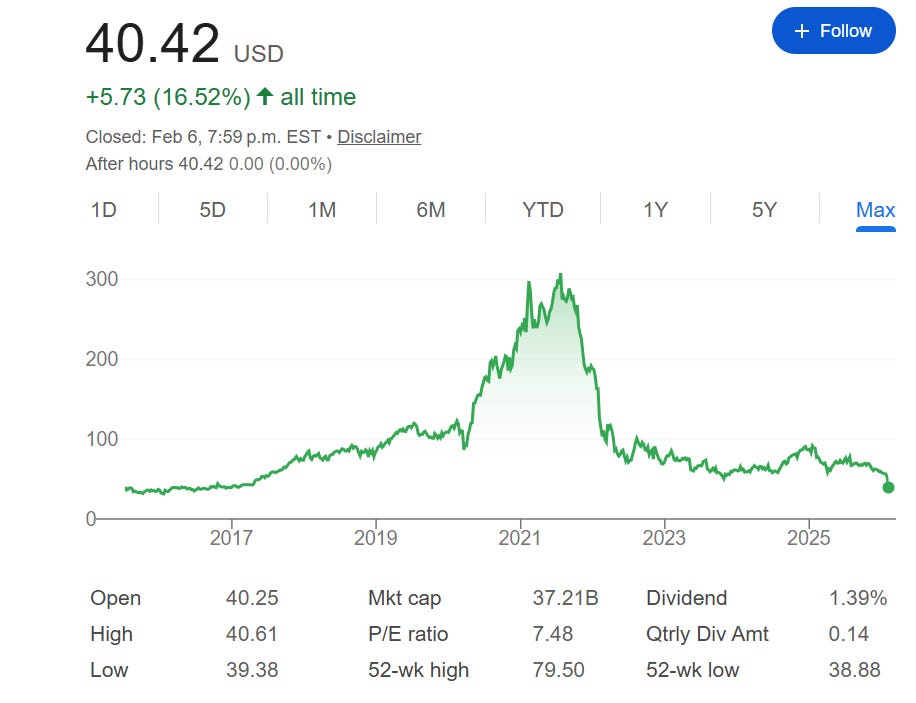
As of early February 2026, the stock is in free fall. The market is valuing PayPal as though revenue has peaked. For some value investors, they look at the stock and see a wonderful opportunity to pick up an established name facing overly bearish sentiment for cheap. Which one is it?
Dead Man Walking or Wolf in Sheep’s Clothing?
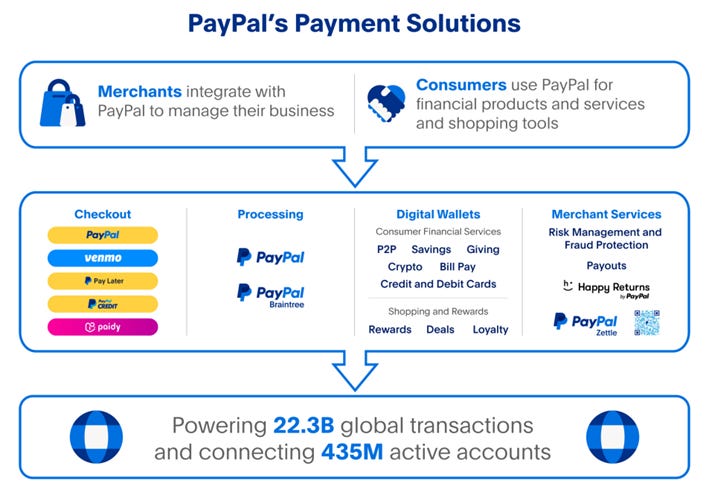
PayPal operates in many aspects of financial services but they still generate the bulk of their $32B in annual revenue from transaction volumes. They charge fees to customers or merchants for processing payments. Unlike other fintechs, they have not pursued a bank charter which prevents them from lending off their balance sheet. This allows them to operate an asset light business with less regulatory overhead but it relies on growing transaction volumes and capturing fees. There’s an estimated $2-5 trillion in global payment revenue, but also plenty of competition.
Competition
While PayPal is still one of the most widely downloaded and used financial services apps, they face credible rivals at every layer of the stack.
On the peer-to-peer (P2P) side, PayPal and Venmo compete directly with Cash App and Zelle, both of which benefit from tighter bank integration and faster settlement for domestic transfers.
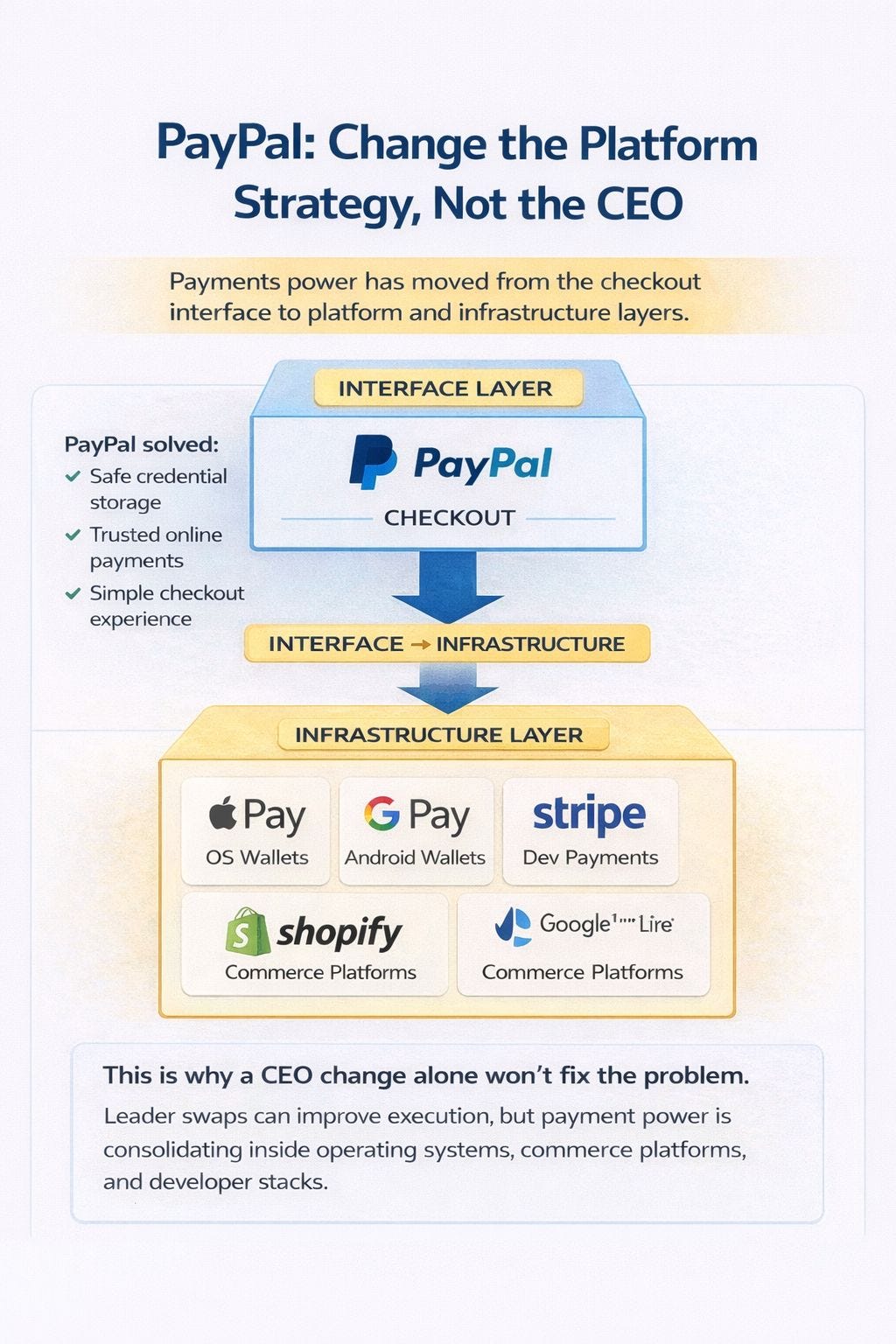
In online merchant checkout, competition is even more intense. Shop Pay dominates within the Shopify ecosystem, while Stripe has become the default choice for developers and modern internet businesses. Layered on top of checkout are Buy Now, Pay Later (BNPL) providers such as Klarna and Affirm increasingly own the consumer relationship at the moment of purchase, relegating PayPal to a background funding source rather than a front-end brand.
For in-store payments, PayPal has to contend with hardware-plus-software ecosystems like Square, as well as platform-level wallets such as Apple Pay and Google Pay. Not to mention the traditional credit card networks, Visa and Mastercard which still control the rails PayPal relies on.
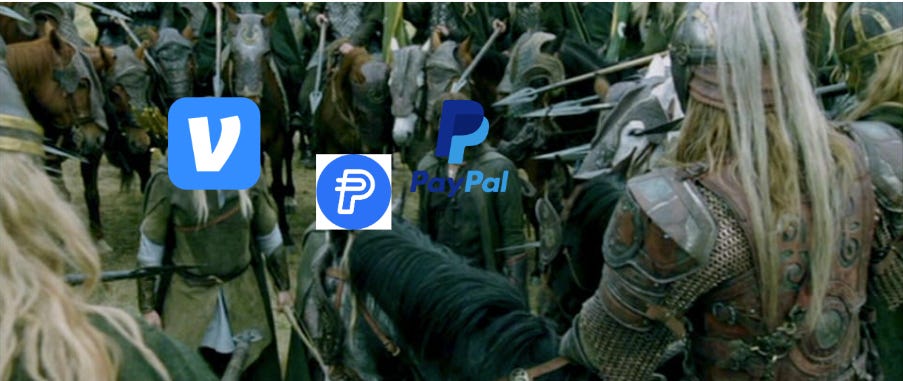
PayPal is getting squeezed from every direction, and they haven’t been able to respond with enough new and exciting products to maintain payment volume growth. Merchants are starting to abandon them for cheaper and better solutions offered by Stripe, Shopify, Adyen and others.
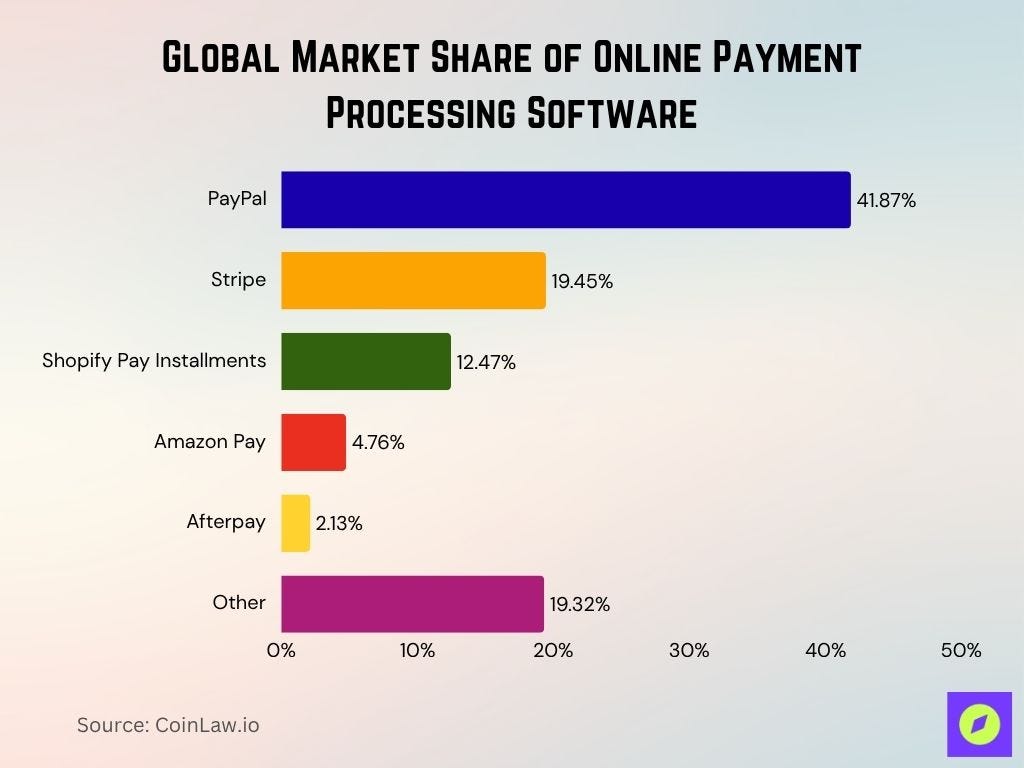
PayPal still has the leading market share amongst these apps in terms of payment volumes and users but the question is durability. Most estimates say have global TPV grew around 4% in 2025, which is around the same rate PayPal grew. Payments isn’t a fast growing industry, PayPal and these other fintechs are in competition to pull volume away from banks, credit cards and legacy players.
What’s concerning, is that PayPal is increasingly looking like a legacy player. They only had 1% growth on their online branded checkout business, which is a higher margin product. If merchants start abandoning them, their business starts to look weak very quickly. Which begs the question. If their product keeps being viewed as subpar, how much longer can they keep this market share?
Non-Cohesive Product Strategy
The UI needs to be refreshed; the product feels closer to a legacy bank than a modern fintech. I tried using PayPal to send money to a colleague last week and it showed why they are stalling.
It took 8 days to send money from Canada to the US, and I had to abandon the mobile app to send the money via desktop to avoid paying FX conversion fees twice. Not inspiring.
Next time, I’m sending JP the money via a Stablecoin (click here to learn what that is). Stablecoins are a clear threat to cross border payments, which have been a great source of fees for companies such as PayPal, Western Union and banks.
To their credit, PayPal identified this and launched their own a few years ago, PYUSD, but adoption is low. As Marcus claims, “The product is sound but it launched without a compelling transactional reason to exist. PYUSD had distribution, but no organic demand. It was not embedded deeply enough into flows to become a true settlement layer, a cross-border merchant rail, or a programmable money primitive. It sat adjacent to the product instead of inside the core of it.”
PYUSD has a weird value prop. Crypto people don’t want to use a token launched by a fintech. Even for people who don’t mind, it’s less liquid than USDC or USDT, and less widely accepted. As currently construed, it’s not clear why anyone would use it.
If they were focused on driving adoption, they would just embed PYUSD into the background of their product, and use it as their new payment rails for international transfers. They could aggressively cut fees to take a larger share of the market and drive users into a more integrated product stack. This would hurt their own revenues short term but if they aren’t willing to integrate it into the product, why have it all?
This was a common theme with PayPal over the past decade. They would acquire companies for their products but they wouldn’t integrate them. Venmo remains a separate product ten years later. That lack of integration didn’t matter when e-commerce and mobile adoption provided strong tailwinds. It matters now.
(If you want to learn more about payments or the fintech landscape, check out Simon Taylor)
$PYPL Stock Analysis
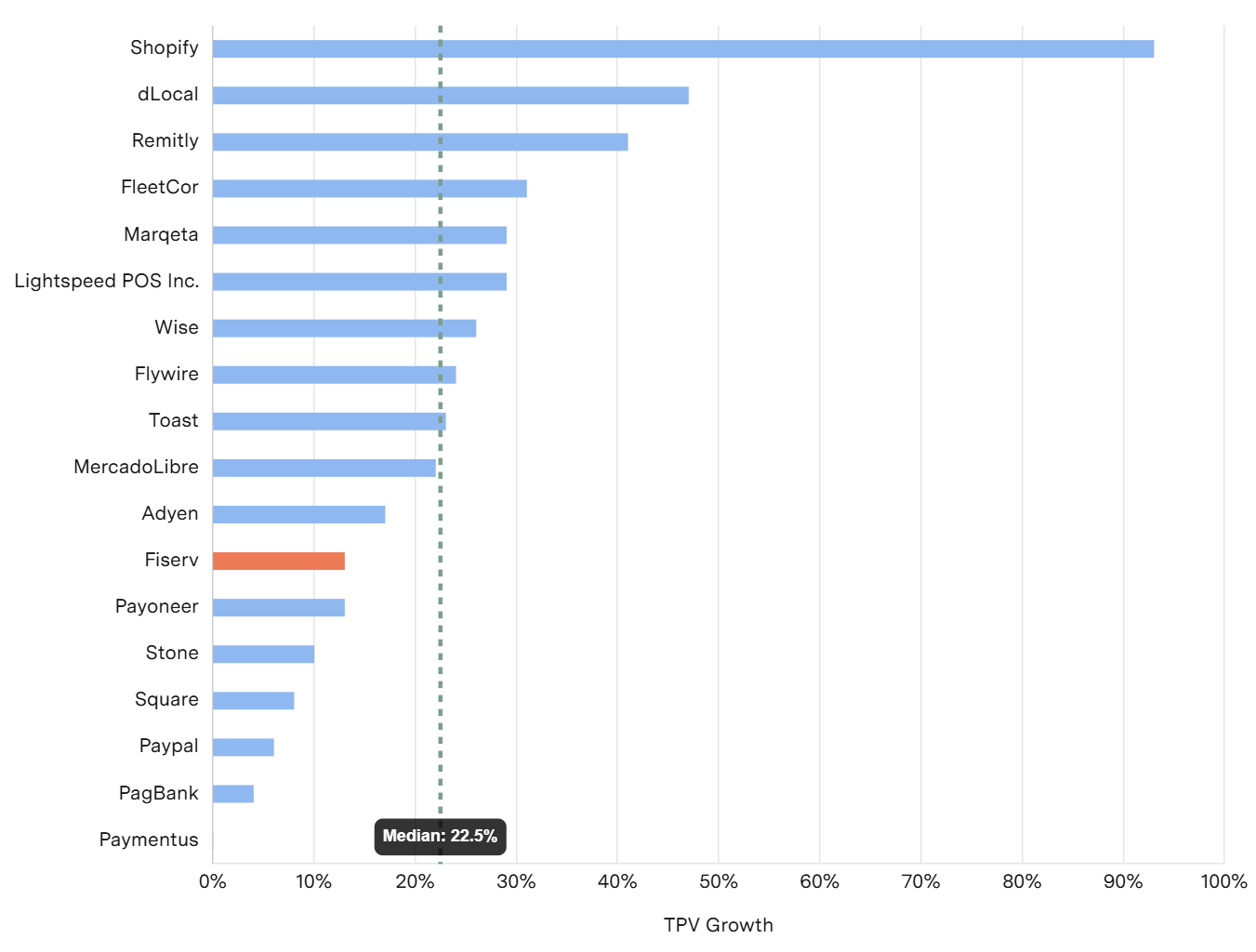
Today, PayPal is no longer a growth company. In 2025, revenue grew just 4.3%, only slightly above inflation. The stock trades at 1X revenue, which is below most fintech peers at 2.5–4×, and widely below where it was after the sharp multiple compression across the sector since 2021.
From a profitability standpoint, PayPal sits in an interest spot. They have operating margins near 20%, and net income margins of ~15%, which compares favorably against median fintech (8.62% and 4%), but poorly against large banks such as JP Morgan, Goldman Sachs etc., with margins north of 40 and 30%.
You would expect the asset light, tech forward business to be growing faster or have better margins. In the case of PayPal, if they can’t reinvigorate growth, they need to improve their margin and cashflow profile or else they sit in no mans land.
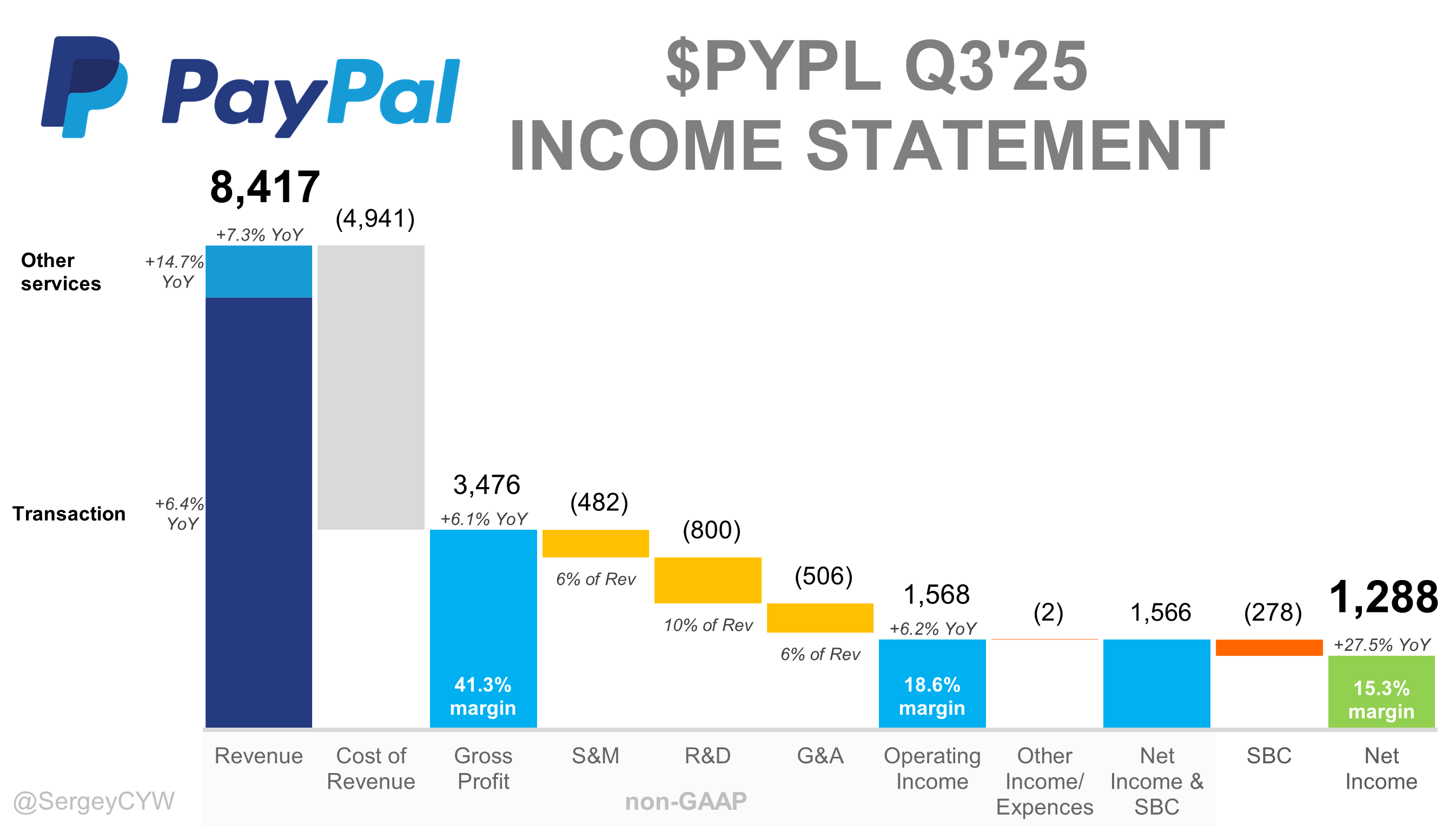
What investor will get excited about holding a low growth, medium profitable fintech that doesn’t pay dividends? At this point, you would only be buying the stock because you think it’s cheap, and it definitely is. PayPal only trades at 6 times operating cash flow, ~5X EBITDA. This trades like a business the market doesn’t think will endure.
Provided their revenue doesn’t immediately start plummeting, at these prices it seems difficult to envision multiples compressing further. At the same time, unless they return to double digit growth, they won’t command multiples close to Shopify or Adyen (~10X sales) either. Those companies can grow 20-30%, with similar or better margins. Therefore, you probably can’t get a great return just waiting for multiples to drift back towards median values.
If you’re buying the stock, you need to have confidence the new regime will find a way to return to growth by driving greater product adoption. Unfortunately, the company has struggled to do this consistently. They have a difficult time launching new products internally and when they acquire companies, it takes too long to integrate them. The constant turnover of executives doesn’t help, and their competitors aren’t going to just let them keep their market share.
Alex Chriss was supposed to be the product focused CEO, but his tenure was short. He promised to shock the world back in January 2024. The world wasn’t shocked, I don’t think anyone even noticed. Now Chriss is being replaced by PayPal Chairman and former HP CEO Enrique Lores. He’s neither a payments or product person.
He might only be temporary but for time being, it seems like they are sticking with a similar executive profile that got them into their current mess. If they are going to turn things around, they need to make some major changes to their product and this won’t happen in a few quarters.
Their other choice is to copy the Private Equity playbook and try to run the business with far fewer than ~27,500 employees to boost profitability. This might help margins but it won’t help growth. Private equity rarely makes products better.
In either case, they can likely keep meaningful share of the market for a few more years, largely because inertia is a powerful thing, but the market won’t reward them with a higher multiple. If you are buying the stock today, it’s not because PayPal has shown anything to deserve it but largely because it’s cheap.
Conclusion
Early PayPal succeeded because it solved a problem no one else could, in a new way. It built a product people needed, that helped propel ecommerce and the internet forward. They prioritized product conviction over short-term financial optimization.
Once acquired, that changed. Preserving existing revenue streams became more important than inventing new ones. PayPal did just enough to defend its position, but not enough to redefine it.
Despite an extended cold streak, PayPal can’t be counted out yet. Scale, distribution, and trust matter in payments, but not forever. Right now, PayPal’s relevance is sustained more by inertia than inspiration.
What happens next will determine whether PayPal becomes a case study in slow decline, or one of the rare incumbents that successfully reinvents itself. That outcome won’t be decided by margins, buybacks, or cost cuts. It will be decided by whether PayPal once again chooses to build something genuinely new, even if it disrupts its own business in the process.
Until then, the stock will probably continue to look cheap.
Thank you for reading. If you liked this article please Subscribe below. I publish articles on a wide range of topics from business, books, current events or anything on my mind.
Great stuff!
A thorough analysis highlighting how PayPal’s shift from pioneering fintech innovator to a more conservative operator illustrates the long-term impact of strategic and cultural decisions