

Unless you are returning from a week long silent retreat/digital detox, you will have undoubtedly heard all about SpaceX’s long awaited initial public offering on Friday. Priced at $135 per share, SPXC 0.00%↑ finished its first trading session at ~$160, valuing the company above $2 trillion dollars.
This is by far the biggest IPO in history, and prices SpaceX comfortably within the 10 largest public companies by market capitalization. Higher than Tesla ( TSLA 0.00%↑ $1.6T) META ( META 0.00%↑ $1.5 T), and Berkshire Hathaway ( $BRK-B $1.1T) or JP Morgan ( JPM 0.00%↑ $1T).
Looking at financials alone, this doesn’t make much sense. SpaceX generates ~$20B in annualized revenue, but has a ~$5B operating loss and -$20B free cash flow. Other trillion dollar companies generate >$100B revenue while being highly profitable.
Investors know this yet still the stock price soared because in the short term the stock market is a voting machine. There are more people wanting to buy than sell shares. There are many reasons why people would want to be a SpaceX shareholder.
Regardless of what you think of his politics or whether billionaires/trillionaires should exist, you are a delusional hater if you don’t think Elon Musk is one of the greatest entrepreneurs ever. Up there with Jobs, Vanderbilt, Edison, Ford and other titans.
For nearly three decades Musk has made doubters look foolish. Whether it’s online payments, electric cars, or rockets, Musk finds a way to win. This inspires a level of patience and devotion amongst employees, investors and customers that few big company CEOs can enjoy. While this is part of what makes SpaceX and his other companies great, it’s also why it makes his companies terrible stocks to buy today.
If your goal is to generate alpha, buying great companies alone won’t do it. You need great stocks. Right now SpaceX trades at an outrageous multiple, with a limited float and buying shares around the time of the IPO is usually an easy way to get rugged.
Keep reading to find out why you should not buy SpaceX right now.
Book I’m Currently Reading:
Devil Take the Hindmost: A History of Financial Speculation by Edward Chancellor
Book Most Recently Purchased:
Confessions of an Advertising Man by David Ogilvy
*Note: To ensure you don’t miss my emails please star or reply to this message
In case you missed them, here are some other recent articles to check out:




Stocks Go Up Because People Want to Buy and Hold Them
Imagine two identical companies. Company A announces they intend to wind down operations at the end of the year. They will honour any existing performance obligations, but not make any new sales. They will sell off all assets, settle any liabilities and distribute the difference to their shareholders at the end of the year. Meanwhile Company B will continue operations for the foreseeable future.
Would you pay more for a one time $250 payout in 6 months or $100 annually for the next 20 years? What if that $100 increased by 10% each year?
If an investor thinks a company will have more earnings to distribute to them in the future, they will pay a higher price to own it. If many investors share this opinion, the market clearing price, where demand meets supply, will rise.
When you see a stock price oscillating, this is a reflection of buying versus selling pressure. The market can be willing to pay up for a stock one day, then shun it the next. This can be driven by investors changing their outlook on the business, shifting preferences between near vs long term cashflows, available liquidity in the financial system etc.
Great companies can perform poorly in the stock market over extended stretches because it doesn’t fit with what investors are looking for. High growth tech companies with negative earnings were in great demand during the Dotcom Boom and ZIRP eras, but out of favour during high interest rate, low liquidity regimes. The time and price you choose to buy a stock along with your holding horizon will have as much if not more of an influence on your investment return than the companies performance.
This is why being a great company doesn’t on its own guarantee a high share price. Does SpaceX qualify as a great company?
SpaceX Is Not a Rocket Company. It’s an Elon Musk Conglomerate.
SpaceX started as a rocket launch/space company 20 years ago, but today you can think of it as three separate but related businesses:
Space - Rockets (Falcon, Starship, Dragon etc.)
Connectivity - Starlink
AI - Compute Business (Grok, Cursor)
The Space division is responsible for decreasing the launch cost by about 85% down to $2,700 per KG (down from $18,500 historical average). This cost reduction has saved US government agencies such as NASA, DoD, NRO along with commercial satellite operators billions of dollars. Beyond the immediate cost savings, it makes it economically feasible to do new things in space, from building data centres and colonies to enabling low-earth orbit broadband and mobile satellites. This segment does about $4B in revenue and has grown 8% year over year (YoY).
The Connectivity division sells secure and high speed internet connections to consumers, enterprises and governments. Starlink is ideal for underserved rural and remote areas, or areas with compromised internet access like Ukraine or Iran. Starlink began in 2020 and generates >$11B in annual revenue, growing 50% YoY.
The AI division (previously xAI) merged with SpaceX in the past year. xAI was the merger of Grok and Twitter and as of March 31st were doing $3B annually growing 22% YoY. They have since secured >$15B in annualized revenue from deals with Anthropic, Google and others. They recently acquired the right to purchase Cursor.
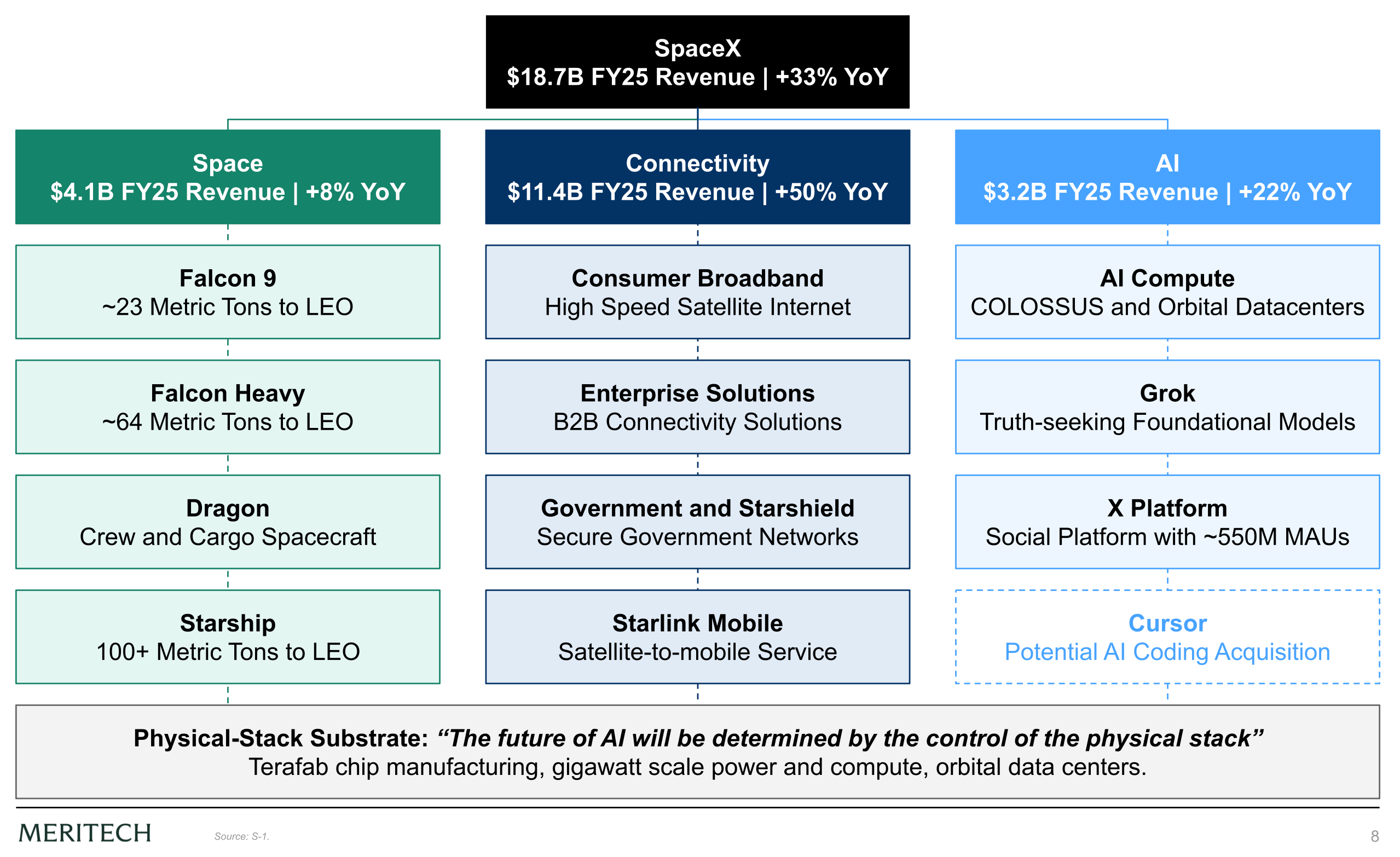
The Space division is launching more rockets per month than every other player combined. Their competitor Blue Origin doesn’t even have a launch pad right now. Starlink has been in business 6 years but generates nearly as much revenue as Canadian telecom giants Bell Canada and Telus. The AI division is getting paid billions per month from competitors, because they have capacity at a time when people are desperately seeking it.
SpaceX is a great company. That doesn’t mean it’s a good stock.
SpaceX’s Greatest Asset Is Also Its Greatest Risk
Greece’s conquest died with Alexander.
Great-man companies inherit the same problem. When the founder is responsible for a disproportionate share of the vision, talent recruitment and investor confidence, succession is not a normal management transition. It’s an existential valuation event.
This is the biggest risk to SpaceX shareholders today. What happens on the day Elon isn’t there? There is no way to justify the IPO valuation without an unwavering belief in its founder.
Based on Friday’s performance, a lot of people believe in Musk to the tune of 100X revenue. This is great for anyone who owned shares pre-IPO but very expensive for somebody buying the stock today.
Compared to other companies at this scale, SpaceX would need at least $100B in annualized revenue to justify a $2T valuation. That’s 10X where they were 3 months ago. Not only would they need to quickly scale their revenue, they would need to show a path to get operating margins in the 30-40% range. None of the trillion market cap companies with >10X revenue have operating margins below 40%. The only exception to this is Tesla, another Musk company.
Most expect SpaceX and Tesla will merge. Taking Friday’s share prices, the entity would have a combined market cap >$3.5T with ~$110B in annualized revenue and operating profits of -$1B (assuming they can’t find any synergies). That’s a more manageable 35X revenue, but still well above any of the other companies.
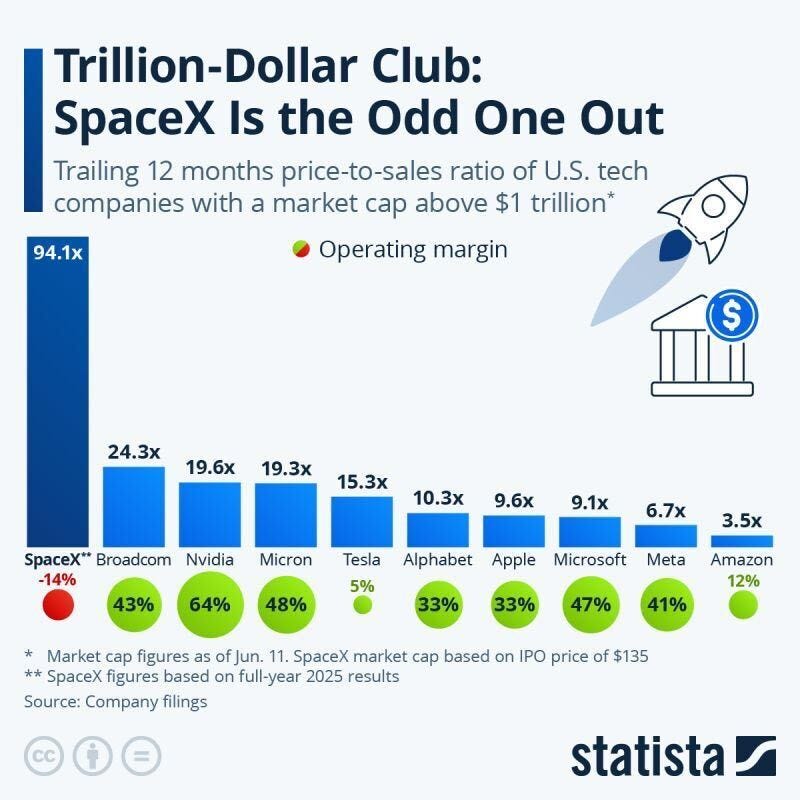
Until then, investing in SpaceX at 100X revenue, is effectively taking early stage venture capital uncertainty but paying mega cap IPO prices. You need to believe the company can double revenue for the next 3 years just to catch up to where their peers trade today. That leaves no margin for error, which seems like an unnecessary risk.
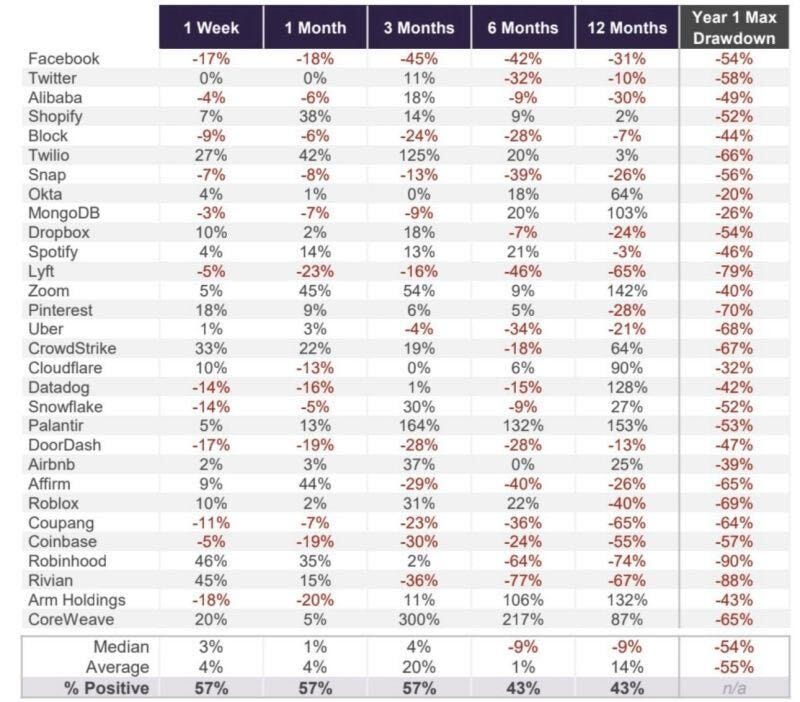
SpaceX definitely isn’t the first company to go public at a rich premium, but when you look at short term stock performance from recent IPOs, its rarely beneficial to buy within the first day or even week of trading. It’s common to see a stock drop 50% below its IPO price within its first year of trading.
Last year Figma ( FIG 0.00%↑ ) reached a peak share price of $122 on its first day of trading (3X the initial offering price) but can be bought for below $20 right now. Figma has grown revenue nearly 50% YoY and beat its latest earnings estimates in a major way, but only trades at 10X revenue for a $10B market cap.
Figma and SpaceX aren’t comparable companies but they are part of the recent wave of IPOs that feature a limited float, which makes the price susceptible to large short term pumps. The float is the number of shares that are available to be bought in the open market. Every company has a certain number of shares held by insiders or part of the company’s treasury, that are restricted from being sold. The higher this ratio, the easier it is to distort the share price.
Assume a company has a million shares, but nine hundred thousand are held by the CEO who won’t sell, it doesn’t take much to pump the stock. One whale can make it surge with the purchase of 10,000 shares. The buying pressure wins, which sends the stock to the moon. This is a common feature in crypto coin offerings, most of which are nothing more than orchestrated rug pulls. If you timed it correctly, you could make anywhere from 50-1,000X your money in an hour. Most participants were unfortunately bag holders. In the case of SpaceX, it’s hard not to feel like one.
Only 4-5% of SpaceX shares are part of the public float. Most mature public companies float 60-90% of their shares. SpaceX’s float is slightly more aggressive than recent tech IPOs between 10-15% (such as Circle, Uber, SoFi) but not unprecedented. Figma, Robinhood, and others were between 5-10%. Robinhood’s HOOD 0.00%↑ trading debut wasn’t as explosive as Figma’s but it opened at $38 and reached a peak of $55 after a few weeks before dropping below $10 per share within its first year.
These limited floats aren’t necessarily designed to fleece public share investors. It’s common for founders at VC backed companies to own more shares in their companies compared to most public company CEOs. In the case of SpaceX, Elon Musk owns ~40% . For reference, Jensen Huang from NVIDIA has less than 4% and Mark Zuckerberg has ~14%. Both companies have been public for a while now.
It’s also normal for pre-IPO shareholders to be subject to an 180 day lockup before they can sell their shares. This temporarily suppresses the float. Once it expires, the share price usually takes a hit as early investors and employees look to cash in.
In the case of SpaceX, the lockup is structured differently. Musk and some early investors are subject to a 366 day lockup, whereas other pre-IPO shareholders are locked up for a maximum of 180 days. Some can be released earlier based on certain milestones. In 6 months, the shares that would be eligible to be sold that could contribute to the float could reach up to 60% (if all these investors choose to sell).
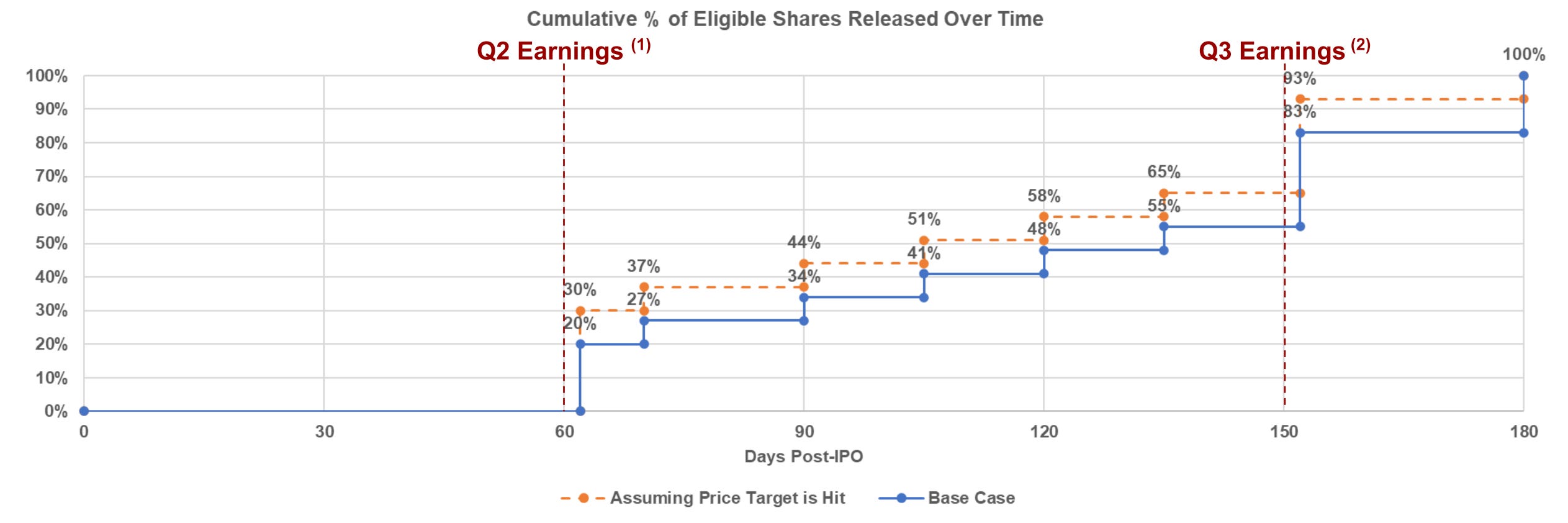
Certainly not all of these shareholders will sell, but a 30-60% post-lockup float is pretty normal for new IPOs. With Musk owning such a large number of shares, it places a ceiling on how big the float will get, but the point remains, the way the stock trades during the early days or weeks post-IPO is not really reflective of where the stock will be in a year.
The way the stock trades before the lockup starts to expire, isn’t really reflective of how the broader market views SpaceX stock. Musk successfully convinced NASDAQ to relax their policies around float percentages which means by default many index funds need to buy SpaceX. Since an increasing portion of the market is held in these passive funds, billions of dollars will be directed towards SpaceX shares, and there won’t be any selling pressure for at least the next few months.
This sets the table for SpaceX’s price to support the current valuation, and potentially climb in the short term, but in the long term, the market is a weighing machine. I suspect people will look at META, Microsoft and Alphabet at 10X revenue and 30-40% operating margins, and wonder if it’s worth paying 100X for a moonshot, no matter how much they believe in Elon Musk. SpaceX might very well one day start space colonies and become the most profitable company ever, but in the short term investors are asked to buy into a completed story, that’s only just begun.
Thank you for reading. If you liked this article please Subscribe below. I publish articles on a wide range of topics from business, books, current events or anything on my mind.
(Check out this great breakdown on the SpaceX S1, from Meritech Capital )