

There’s a lot of hand-wringing about AI-generated slop ruining the internet. I’d go further: there’s too much garbage content in the world, human or machine-made.
Most of it exists for engagement farming, to drive clicks and make money. That didn’t start with the internet. Media companies have been serving nonsense for as long as they’ve existed. There’s nothing wrong when it’s purely to entertain.
While not my cup of tea, adults can watch as much bad TV they want. Binging The Kardashians, Selling Sunset, etc. should not change your understanding of the world.
Things get dangerous when nonsense masquerades as credible information. When people take it at face value, it warps their understanding of reality and weakens everyone else’s. Knowledge and truth don’t exist in a vacuum. Either can be disproven at any time and are only useful if people believe them.
Belief is optional. People can ignore mountains of proof, evidence, data and facts. They can shop around until they find anything that confirms their view. It’s even been suggested there is no such thing as the objective truth. Each person has their own lived experiences and truth, which they may consider equally valid to empirical research or well documented facts. The way they see the world will inform how they react to information.
Remember the uproar over “fake news” and “misinformation” during Trump’s first term? Anytime the media attacked the President, his supporters dismissed their claims as lies, while detractors were convinced every word was true (remember the Steele dossier?). Once Biden took office, the outrage flipped sides. This happens every time a new party takes power.
The truth is, most people don’t seek information to understand the world; they seek confirmation. Unfortunately, even the earnest get deceived. It’s not just Russian bots. Journalists, academics, and credentialed experts are just as guilty as spreading misleading, deceiving or straight up wrong information.
How often have you heard somebody start or finish a sentence with “That’s a fact” only for them to accompany those words with something that isn’t actually a fact? Despite more people attending higher education, the population hasn’t gotten better at separating fact from fiction. Universities care more about their rankings and endowments than producing alumni capable of deciphering signal from noise. This is why being able to navigate truth from fiction, you need to learn this on your own. Here are some tools to help:
Keep reading if you want to learn to detect real from fake insights !
But first, make sure to hit the Subscribe button to join 1,000+ other Subscribers that get Serviceable Insights delivered directly to their inbox each week.
If this week’s article does not interest you, please check out some other recent ones:


What Is The Truth?
“ In a time of universal deceit – telling the truth is a revolutionary act.” — George Orwell
Ask Chat GPT for the definition of the word truth. It returns multiple responses depending on the context. There’s the truth in a general sense. She said it was raining outside, while it was raining at that time1. However, in a philosophical sense, the truth doesn’t have one homogenous definition.
Correspondence theory would align with the general sense. A statement is true if it corresponds to what can be observed in the real world. We can step outside and feel the rain on our skin. Therefore if somebody says it is raining, there is an easily verifiable way to confirm this is the truth. This is the most restrictive definition of the truth, since it’s not always possible or feasible to easily observe each claim.
Coherence theory is slightly less restrictive. Truth is determined by how well a statement fits with a consistent set of beliefs or propositions. We can accept something as true, if it aligns with everything else we accept as true. If we are in a room with no windows but can observe there is no change in moisture, atmospheric pressure etc. we can rule out it’s raining without needing to go outside and verify.
Pragmatic theory is even more expansive. The truth is what works. What proves reliable or useful in practice. Dare I say Serviceable? We can’t prove the sun will rise tomorrow but given this has happened every day as long as the sun and earth have existed, we can safely assume it will. We need assumptions like this to make any decisions for the future.
The most open interpretation of the truth comes from Constructivist theory. The
truth is created through social processes, it’s whatever society agrees is true.
The truth most people believe in, conforms with Constructivist theory. Few people do primary research themselves, they take cues from the people around them. The famous Asch conformity experiments demonstrated an individual will abandon what they believe they know to conform due to social pressure. (This is the line experiment).
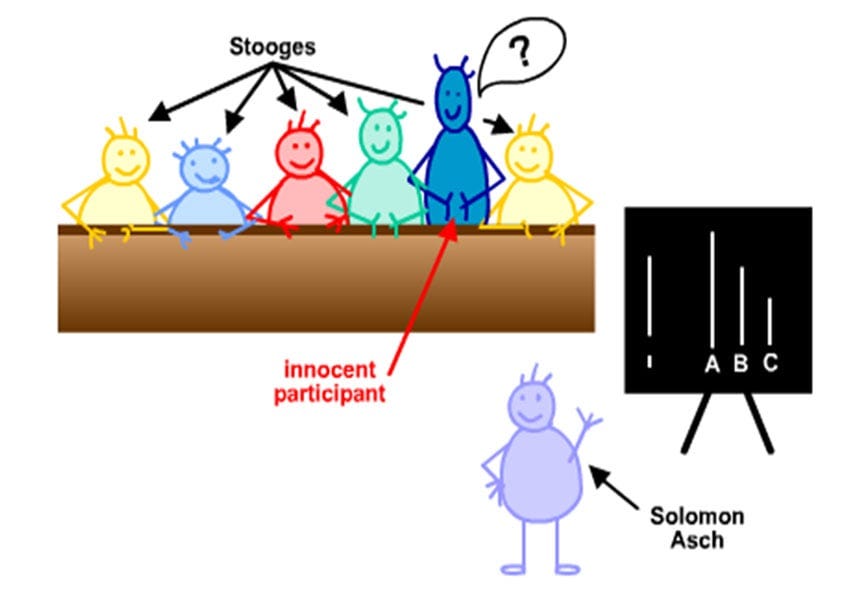
(The stooges all confidently called out that B was the longest line, until eventually the innocent participant would start calling out the same answer)
Therefore for all intents and purposes, the truth is the set of facts and beliefs the most people subscribe to. Whether they are true are not, is largely irrelevant since most statements or facts are not as easily disprovable as looking out the window. Few people will verify things on their own, therefore they outsource this work to people they trust. Teachers, journalists, authors, academics & Substack writers etc.
These groups are the designated and self anointed guardians of the truth but many are just as clueless. They claim to be experts with superior knowledge and context to decipher the truth, see fact from fiction but in reality they are the blind leading the blind. Just with more certainty they are right. They have plenty of facts and data to support their believes giving them the utmost confidence they can’t be wrong.
Some will disparagingly refer to this as Liberal Arts Confidence.
People with this illness can be deceived into believing outrageous ideas completely divorced from the reality because somebody they like/trust share a few facts that align wit their world view. They accept this as dogma because people care more about winning arguments, or imposing their beliefs on others than discovering the truth in a correspondence or even coherence manner.
Society encourages this. People will claim to have a truth, to gain trust and power. Politicians will claim to have the truth that will improve their citizens lives. Execs promise investors they know how to lead their company to success. Journalist’s and authors make big claims to get attention, clout and sometimes change.
The verifiable truth doesn’t always align with these people’s agendas, therefore they make their views the truth by making it the consensus belief.
How do they do this? Praying on people’s biases. The modern version of the truth hides behind data and data is the new propaganda medium.
You Don’t Even Know What a Fact Is
“Trust, but verify,” — Russian proverb popularized by President Reagan
It’s easy to convince somebody of something when they want it to be true.
If you believe LeBron James was better than Michael Jordan, you will be more receptive to an article citing advanced statistics like Wins Above Replacement (WAR) that claim to prove LeBron is the greatest of all time. Even if you don’t understand the statistic, you will likely trust that the data is objective and reliable.
Michael Jordan fans, of course, will reject the premise and respond with other statistics such as titles, scoring averages, or playoff records. Both sides are citing facts, but those facts do not necessarily amount to evidence, and evidence is not necessarily proof.
That is because people usually search for proof to justify what they already believe, instead of reviewing proof to form their beliefs. Whether the claim is true or not becomes secondary to whether it feels right.
The statement “Lebron James is better than Michael Jordan” is not a fact. Without anything supporting this, it’s simply somebodies opinion, sure to upset old heads.

“Lebron James had a greater impact on his teams ability to win” could qualify as a fact, if it had data to support it.
“Lebron’s WAR for his career his higher than Jordan’s” would be a data point, but it’s not necessarily evidence, unless WAR can be proven as a good way to compare players.
Even if WAR is accepted as a valid way to compare players, it’s not necessarily proof because there can be alternate explanations or ways to determine which basketball player is best. Such as team performance/titles, playoff performances, individual accolades etc.
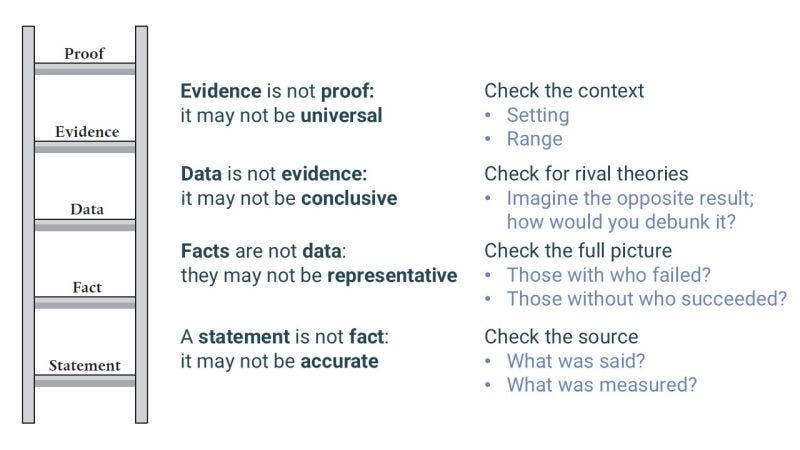
In short:
Statements are not facts.
Facts are not data unless representative.
Data is not evidence unless relevant and conclusive.
Evidence is not proof unless universal.
(This hierarchy and the image below is from Alex Edmans’ book May Contain Lies.)
Numbers Don’t Lie, but People Do
In May Contain Lies, Alex Edmans describes being approached by a major asset manager that wanted to prove a new trading strategy: investing in companies with greater diversity would produce higher returns. Edman could not find any proof or evidence that would indicate such a strategy would work.
Instead of abandoning this quest, the asset manager went to somebody else that used the same data set as Edman, yet claimed it was possible. When Edman investigated, he saw this other researcher manipulated the data to justify the conclusion the asset manager wanted.

The asset manager now had “academic validation.” They used it to market their strategy to institutional investors, raising billions. Other firms copied them. Over time, the claim that diverse companies outperform became consensus truth, despite no statistical proof. The asset manager was not looking for the truth, they wanted the truth that institutional investors already wanted to believe. So they lied.
There might be other valid reasons to invest in diverse companies such as ethics, governance, or culture, but the claim about guaranteed superior returns was false. Most investors did not review the studies themselves, they trusted the credentialed experts. If Edmans did not review the data firsthand, he might have believed it too.
The Limitations of Peer Review
Academics often treat publication and peer review as quality control. In theory, peers play the same role Edmans did, checking whether findings are sound, replicable, and honest.
In practice, this system fails frequently. Researchers shop around for journals with weaker standards. Reviewers may be friends or ideological allies. Critiquing flawed studies can be professionally risky, especially when those studies align with a fashionable or politically popular narrative.
Speaking out against consensus can lead to reputational damage or ostracism. It is easier to stay silent than to be the lone dissenter. That is how Ivor van Heerden, Peter Ridd, Judith Curry and others lost their university positions after challenging dominant views within their fields.
This creates a situation similar to the Asch experiment. If you are the only person seeing flaws with your groups consensus view, few will want to speak out because of insecurity of looking stupid if wrong. Others might decide it’s not worth the ramifications even if they are certain they are right. This is the premise of the story An Enemy of The People: Telling an unpopular truth can make you the enemy of the crowd.
What often happens is that flawed studies go unchallenged but continue to be cited until they become truth by repetition. The researchers begin to win prizes and sell bestselling books, only further adding to their stature and making it more difficult to refute. Once enough people believe something, the burden to convince them becomes increasingly difficult. This problem gets exacerbated by Chat GPT, Google, Wikipedia and others since they prioritize information or articles most heavily cited. Once information makes it onto these platforms they are the Constructivist truth.

Whenever people want or need something to be true, whether it’s that LeBron is the GOAT, that diverse companies outperform, or that a new health trend can fix everything, their ability to doubt disappears. The stronger the desire for something to be true, the more closely you should scrutinize it. When someone makes a claim that runs against their own interests, they are far less likely to be lying.
Our collective understanding of the world is far smaller than we think. Citing facts and studies does not equal knowledge any more than watching sports makes you an athlete. Be skeptical of claims about the world that lack real proof, evidence, data, or facts. The truth is whatever people believes it to be.
Checklist for Smarter Thinking
Alex Edman, author of May Contain Lies was kind enough to include this checklist at the back of his book. These are the type of questions you should ask yourself whenever you see somebody making a claim, whether it’s supported or not.
A. Preliminaries
Do you want the conclusion to be true?
Is the conclusion extreme? Does it suggest something is always good, bad or applies everywhere?
Ex: You can defeat cancer with diet. Carbs are always bad.
B. Statements
Does The Statement Contain a superlative or imply universality?
Ex: “Shareholder value is the dumbest idea in the world. Every company will be a fintech company.
If yes, can you come up with a clear counterexample? (can you disprove the hypothesis?)
Is the statement backed up evidence? Does this evidence exist and is it publicly available? People often cite studies but can’t name a specific one that can be easily audited.
If it does exist, does the evidence and findings from the evidence support the statements?
Do the inputs and outputs correspond to the statement? (does the study actually measure the claim in a rigorous way?)
C. Facts
Does the study test a hypothesis?
Does the study consider a representative sample? (Is the sample size even big enough)
Does the study consider a control group? (same characteristics that achieved the same outcome without factor X?)
Does the study calculate the average output across the two groups?
Does the study check for statistical significance?
Is the difference large enough that it can’t be explained by luck or noise?
D. Data
Are there other ways the researchers could have measured the input and output? (Alternate Hypothesis, Data Mining)
Is the data chopped up? (did they conveniently omit or structure data in such a way to achieve their desired outcome?)
Could the output have caused the input (reverse causation/tail wag the dog)?
Are there any common causes that could be driving both the input and output? Have the authors controlled for them in the same regression?
Imagine if the study found the opposite result. What alternative explanations would you come up with to try to explain it away? Then ask if these alternative explanations still apply, even though the finding are in the direction you like?
E. Evidence
What was the setting studied? Is this the same as the setting for which you’d like to draw conclusions? If not, are there any reasons why the relationship might be different in other settings?
What was the population studied? If this the same as the population of interest for which you’d like to draw conclusion? If not, are there any reasons why the relationship might be different in other populations? (the 10,000 hour rule and others)
F. Shortcuts
You can’t review every cited study but here are some questions to filter if they were performed properly:
Studies
Is the paper published in a top peer-reviewed journal?
What are the credentials of the authors? Do they have a Ph.D or a track record of top peer reviewed publications in the relevant field? Are they affiliated with the leading research institution? If the same study was written by the same authors, with the same credentials but found the opposite results, would you still believe it?
What are the authors incentives to claim their result? Would they have published the paper if it had found the opposite result?
Do the authors exaggerate their credentials, the rigor of their methodology, or their conclusions?
Books and articles
Does the book or article back up its claims with evidence?
Can you find informed critiques on the web?
Is it balanced? Does it consider evidence or arguments that contradict its core thesis?
Do the authors exaggerate their credentials, the rigor of their methodology, or their conclusions?
Thank you for reading. If you liked this article please Subscribe below. I publish articles on a wide range of topics from business, books, current events or anything on my mind.
Besides that one annoying person that will try to argue “It’s only raining in that location but what about elsewhere?”. There’s always one.
The pragmatic view is that utility > truth, not that utility = truth. Or in other words, "all models are false, but some are useful."
The constructivist view is that there is no truth, only authoritative claims.
Both of these ideas are unconcerned with truth and to show that's the case is trivial and completely misses the point.
Anyone who accepts the premise that truth exists already agrees with you, and anyone who doesn't won't be swayed by explanations ignorant to their actual concerns.