

Science fiction can’t help but grapple with the idea that we live in a simulated reality. It’s because increasingly, we do. Just not in the way Hollywood depicts it.
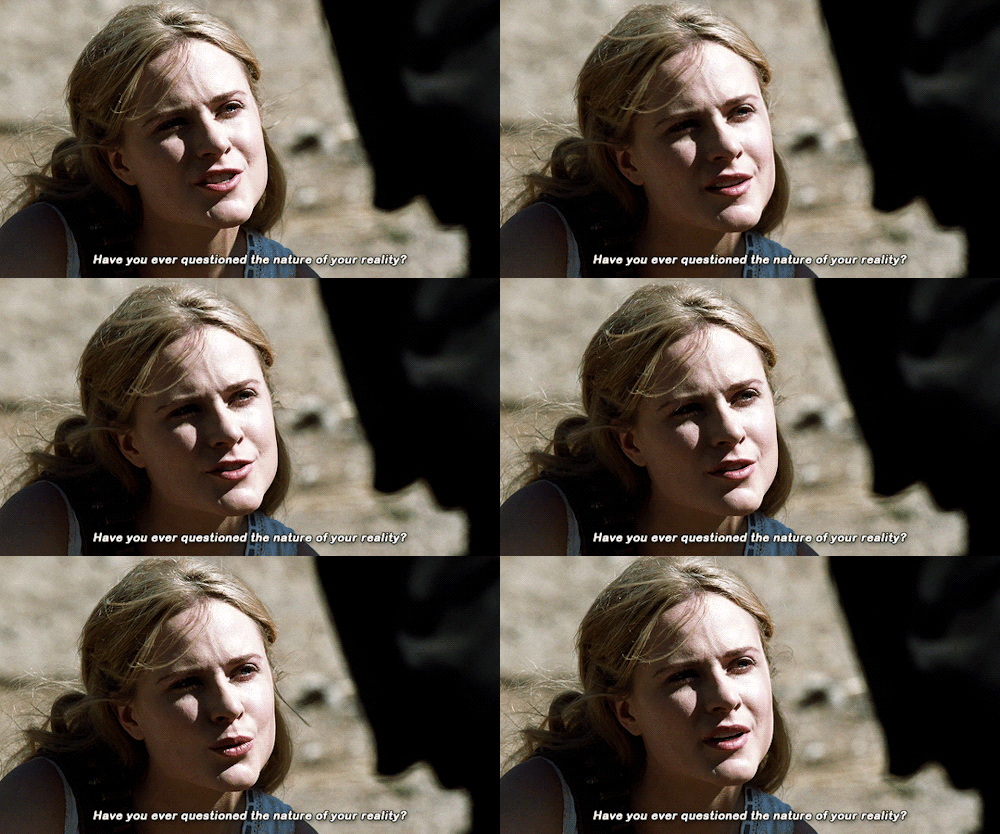
In the series Westworld, visitors knowingly enter a theme park of humanoid robots so convincing that the line between performance and consciousness begins to blur. In The Matrix, humans don’t realize their consciousness is just a projection of a simulated reality from a computer program.
Both stories explore what happens when simulations stop imitating reality and start replacing it. The experience becomes so immersive that participants can’t distinguish what’s constructed from what’s real. Eventually, the simulation no longer references anything outside itself, leaving the participant to accept it as the reality.
ChatGPT, Gemini, and Claude are trained on large data sets representing our world: text, images, videos, human designed programs etc. As they become more effective, people start using them to create these same representations and their outputs become an increasing share of internet content, software code, and white-collar work. They move from mirroring reality to becoming the models the world conforms to.
Until recently we could watch The Matrix, Westworld and other sci-fi and appreciate them as fiction. As society increasingly relies on AI, we trade our reality for one that more closely resembles theirs.
This is not new. Well before LLMs or the internet, Jean Baudrillard noted that society was shifting from using models to reflect reality, to allowing models to become reality.
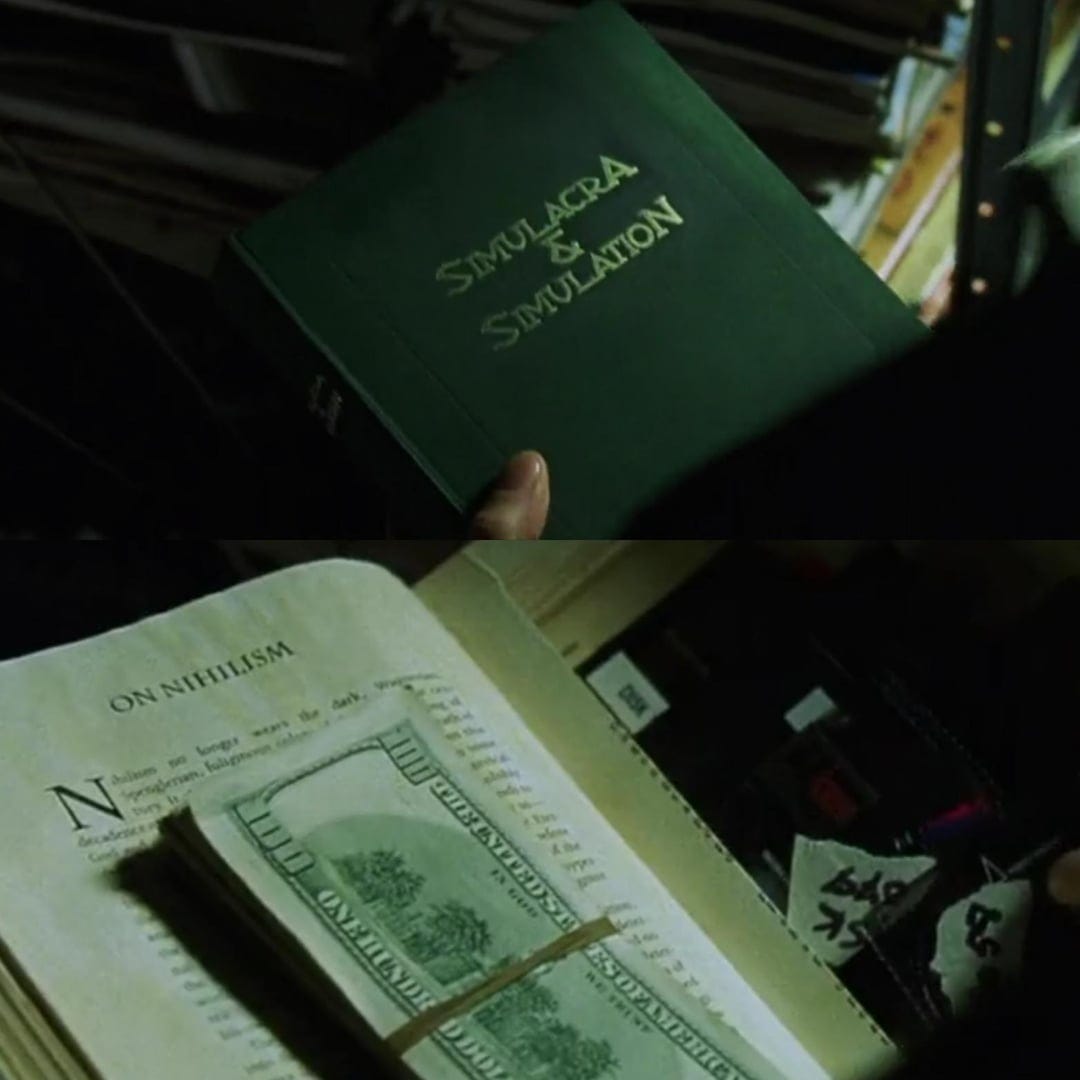
His book Simulacres et Simulation (Simulations) published in 1981, inspired many of the ideas embedded within The Matrix but most were too distracted by Keanu Reeves and his impressive kung fu abilities to notice.
LLMs did not start this condition, but they are the latest edition of the Matrix we are creating. This is not another article claiming we live in a simulation; that question is irrelevant. If our reality becomes indistinguishable from a simulation, does it matter?
If you’ve ever wondered why people like Elon Musk believe we live in a simulation, what Jean Baudrillard saw coming decades ago, and why LLMs bring us further from the truth, keep reading.
If this week’s article does not interest you, please check out some other recent ones:


What is Simulation Theory?
Simulation Theory is the idea that what we experience is not reality but a simulated environment created by a more advanced civilization. The support for this theory doesn’t come from The Matrix trilogy but a probabilistic argument based on assumptions about technological progress and the vastness of the universe.
If we look at how much computing power has increased in recent years, imagine what it could be in hundreds or thousands of years from now. If that trend continues long enough, it would be possible to simulate entire worlds in extraordinary detail, including conscious beings inside them. These simulations don’t need to be perfect copies of reality, just convincing enough to those experiencing them.
Given the vastness of the universe, the likelihood there isn’t at least one civilization that much more advanced than ours, is low. If they can create one simulated world, they can theoretically create infinite simulated worlds, more than what exist in the universe. These worlds would be indistinguishable from one another, so neither people living in the simulated or base reality could know which one they were in.
You can listen to Elon Musk explain it in 2016:
Since we can’t confirm which one we inhabit, taking a Bayesian approach it’s statistically more likely we live in one of these simulations than an organic base reality.
This whole line of thinking was formalized by philosopher Nick Bostrom in his 2003 paper Are You Living in a Computer Simulation?. The paper sparked serious academic debate and remains the foundation of modern Simulation Theory.
However, besides being a fun discussion topic, usually after a few drinks or semi-controlled substances, this theory lacks practical application since it makes no testable predictions and cannot be empirically proven or disproven. It’s like listening to fervent atheists and religious people argue about the existence of God, or Lebron and Jordan fans argue about who’s the GOAT. It can be entertaining but there’s no way to definitively verify which claim is accurate.
If the goal is to understand how simulations shape real behavior, power, and meaning, there’s a more useful place to look. That place is Jean Baudrillard.
A Short Introduction to Simulation by Jean Baudrillard
While Simulation Theory debates whether we live inside a literal computer simulation, Jean Baudrillard was concerned with something more immediate. He was not asking whether reality was fake, but whether the distinction between reality and its representations still mattered.
In Simulacres et Simulation, Baudrillard argues that modern societies have shifted into a new stage of abstraction. Humans used to use images, symbols, and models to represent reality. A map is meant to represent a territory. A photograph is a representation of the subject in the photo. Numbers and statistics eventually tie back to a real world phenomenon. Any meaning derived from these symbols or representations were nothing without an external reference point you can experience.
Baudrillard noted that this relationship had collapsed.
Societies became too complex, which forced us to rely on representations instead of the base entity. Our world became too large to understand so we distilled it into shortcuts: Symbols, models, narratives, heuristics etc.
Over time, these shortcuts were layered on top of one another. Models were built using other models, which were built using earlier abstractions. This resulted in representations disconnected from reality, because they only reference each other.
Instead of the model describing the world, the world was reorganized to fit the model.
Baudrillard called this condition: simulation. A simulation is not a copy of something real, it’s a self contained system of signs that work together to produce its own version of reality. Whether it aligns with the reality the base symbols were derived from is unimportant.
A video game world does not need to obey the laws of physics to feel real to its players. It just needs to be internally consistent. Once that exists, endless content can be generated inside the game without ever referencing the physical world outside it.
Baudrillard argued that modern knowledge increasingly works this way. Look at academia. Claims are often built by referencing other claims, models, and frameworks rather than direct observation. This does not mean they are necessarily wrong, they just operate inside closed systems that most people cannot independently verify. (In many cases they are wrong, for reasons covered in Most of What You Know is Wrong)
As a result, much of what we accept as reality is mediated through layers of abstraction. We can no longer easily distinguish what comes from direct observation and what comes from models interpreting other models.
Baudrillard’s warning was not that this process would happen. It was that it already had… by 1981. Now AI is only going to make this worse.
AI & LLMs Get Us Further From The Truth
LLMs are a great representation of a Baudrillard simulation. Computer programs lack sensory access to reality, so they ingest endless representations, allowing them to produce outputs that appear as if they understand it. Unlike humans, LLMs can never observe any of this “knowledge” in real life (IRL).
To compensate for this, they rely on more representations and reinforcement from humans and other machines to validate their knowledge base. Meaning doesn’t come from observations, just agreement between systems.
(If you want to learn how LLMs work, see LLMs as explained by The Big Lebowski)
LLMs are wonderful at retrieving existing representations, but that’s not how they are being used. Instead of using ChatGPT, Gemini or Claude as a research assistant, users are increasingly trusting these tools to perform the task. This output will eventually become the representation these models will train themselves on.
As AI generated content makes up a greater proportion of content, we enter a Baudrillard simulation. A human coming across this content won’t be able to discern what came from another human or from AI.
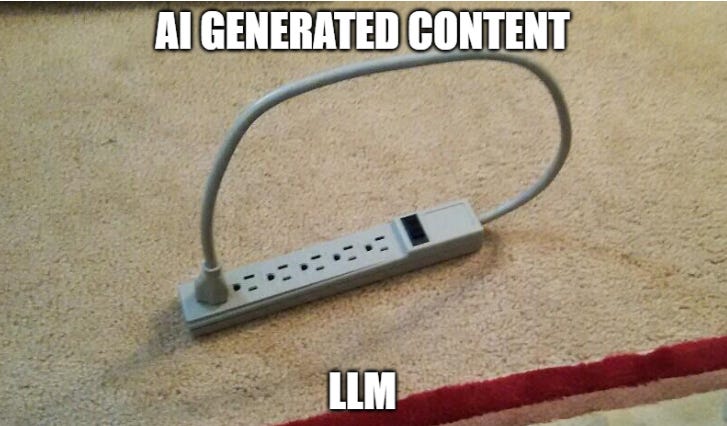
If we haven’t reached that point already, it would appear we’re nearly there. In early 2025, many outlets reported that AI produces more internet content than humans.
At the same time, humans are becoming reliant on LLMs, which we’ve established lack a direct connection to the real world. As the representations they get trained on become more abstracted, the further they move from our reality.
This will make it impossible to tell when an LLM is hallucinating or missing relevant information. Things are quite bad as it is. People make major decisions based on headlines, slogans, or short video clips.
Many who passionately voted for Brexit, shortly regretted it afterwards. Shake weight sold millions of units off hype. Both were before the launch of ChatGPT. This is because humans have always struggled with decision making, we can’t blame AI.
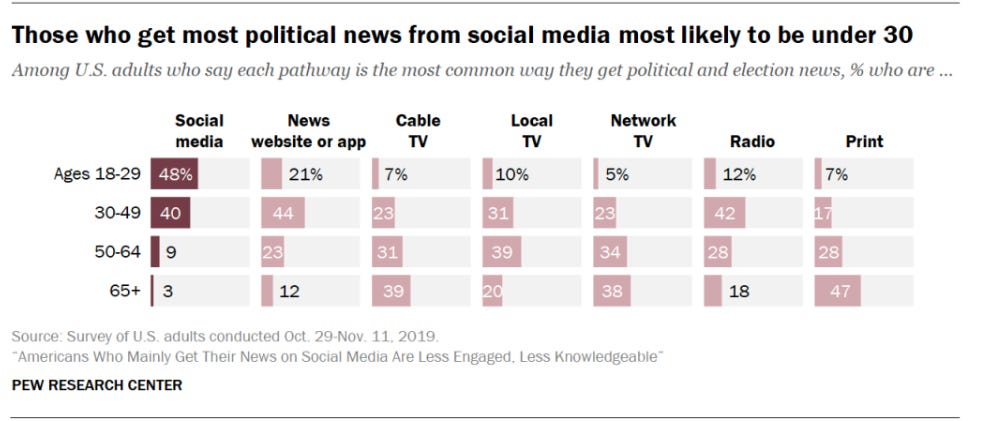
Young people primarily get their information from social media, which is skewed for sensationalism, even if the Chinese government isn’t actively trying to make them dumber. Who can blame them? The platform is fun and designed to be addicting but it contributes to a society that’s poorly informed and less engaged.
It’s a natural progression of delivering content faster and easier. We moved from town criers to print, from print to television, from television to the internet. Each progression should have theoretically got us closer to the truth, yet misinformation remained. Now short form video and generative AI produce a hyperreality made largely of recycled symbols, optimized for engagement rather than truth.
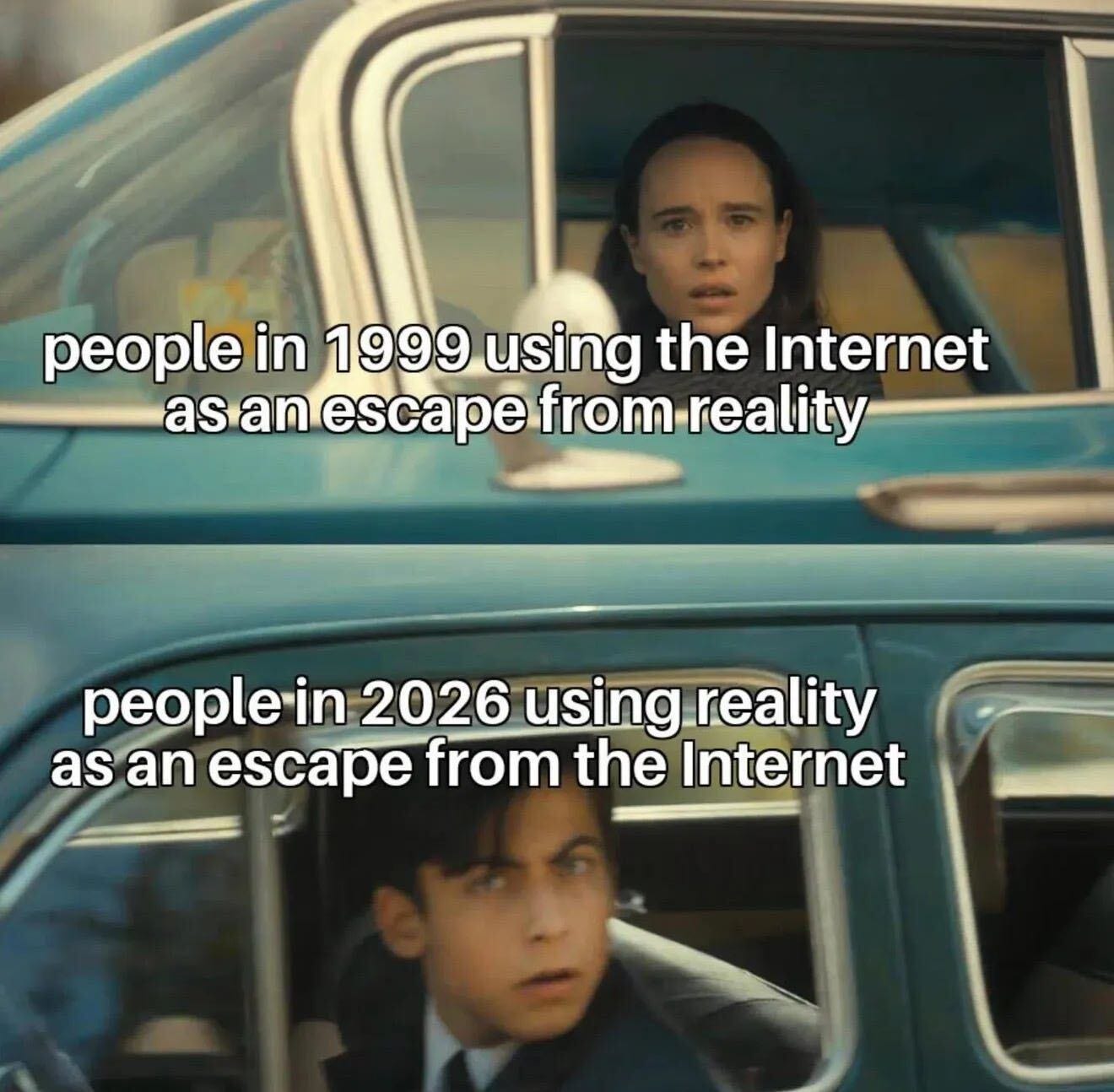
The scary thought is many won’t see anything wrong with this. What does it mean for something to be real? Is there such thing as the objective truth? Finding out the truth of the universe is time consuming and hard, instead people consume useless content to escape from reality. Unfortunately, the longer they stay outside of reality, the faster they lose their grip on it.
This is why the question of whether we live in a simulation or not is no longer a relevant one. We have voluntarily chosen to leave our world behind by choosing the simulation.
In many cases, people only know or interact with the representation. Money began as an exchange between real assets such as fruit for cattle. Then wealth was represented by gold and silver coins. Then paper claims on those coins. Eventually, paper backed by nothing but the faith in government. Nowadays we rarely see physical money, just numbers on a screen. The underlying referent has faded from everyday life, replaced by systems that function because everyone agrees they do.
How much longer will it be until it’s our reality that’s been reduced to a simulation filled with representations with only faint echoes of what used to be the real world.
Thank you for reading. If you liked this article please Subscribe below. I publish articles on a wide range of topics from business, books, current events or anything on my mind.
I was just saying... https://substack.com/@outis9a/note/c-204967718?r=1eolp
What Elon Musk is saying makes little sense to me. He's saying that we are living in a simulation because we will be able to create simulations that are a new reality. So we will be able to create a simulated world peopled by simulated people, who then presumably will advance to create simulations. It's then, as the story goes, turtles all the way down.
That said, the world we live in, and ourselves as well, are very hard to comprehend. It's mind-blowing stuff. Like Elon Musk says, best not to think about it in a hot tub.