

Last week the financial press, Fintwitter and Finstack were thrown into a feeding frenzy when the latest financial Wunderkind’s hedge fund blew up.
Situational Awareness, run by 24 year old former OpenAI researcher Leopold Aschenbrenner was forced to liquidate its public equity portfolio to cover losses after a recent selloff in AI stocks put the fund at risk of insolvency.
The fund which was reportedly up as much as 439% by the end of June, dropped 67% within a few weeks, triggering a margin call, forcing them to sell the majority of its public equity book, to Citadel, the hedge fund led by Ken Griffin. Non-finance folk might recall the firm from the Gamestop saga of 2021.
The public hasn’t been kind to Leopold. Many called him an idiot, ignorant to financial markets, dismissing his prior success as luck etc. This is coming almost exclusively from people who never met him. It’s true he’s new to managing money but he graduated from Columbia at 19, worked at FTX (before it blew up), OpenAI (before he got fired) and is connected with many of the key figures at the AI frontier labs. I doubt his critics can boast a similar track record by the age of 25, or at all.

Leopold is the latest in a long line of fund managers that posted stunning returns for a while before their investment strategy succumbed to the wrath of Mr. Market. Whether it’s Bill Hwang, Cathie Wood, Sam Bankman-Fried or Bernie Madeoff, every few years, the financial press crowns a new Warren Buffett, only for their funds to suffer devastating losses. In some cases blowing up the fund and/or sending the manager to jail. It’s almost a guaranteed kiss of death at this point, like the Forbes 30 Under 30 list.
Nobody has accused Situational Awareness of doing anything shady or illegal but there are a few lessons that can be learned from this episode, some of which were predictable.
Margin Calls & The Situational Awareness Strategy
“Illiquidity, leverage and concentration. Each are a problem but manageable in isolation. If you have two of them, uh oh. If you have all three of them then you are whistling past the graveyard.” — Steve Cohen (sourced from Marc Rubinstein at Net Interest)
Why was the Situational Awareness blow up predictable? They were heavily concentrated into AI Infrastructure names with meaningful leverage. Beyond that, the portfolio was designed to perform well during a looser credit cycle, once money began to tighten, it was inevitable that some of the positions would be negatively impacted. The US-Iran conflict has reduced the supply of energy which has been putting upward pressure on inflation and interest rates which shifts demand for near term cashflows.
The reason Leopold needed to sell his public book as quickly as he did, was because his investment portfolio was trading on margin, which meant he borrowed to place trades. It’s not that different from taking a mortgage.
You purchase a $1 million property with a $200,000 down payment and an $800,000 mortgage. You control a $1 million asset using only $200K of your own capital. If the property rises 20%, you pay back the $800K and your equity is worth $400K. If it falls 20%, the value of your equity is worth zero because the lender is still owed $800K.
The difference is that your bank doesn’t revalue your home daily. Whereas a prime broker continuously monitors the value and volatility of an investment portfolio. When the collateral drops too far, the broker will demand additional capital, reduce the amount it’s willing to extend or begin liquidating positions.
Situational Awareness reportedly borrowed $3 to $4 for every $1 of capital. In that case, a decline of 20% to 25% would wipe out all of the fund’s equity.

Situational Awareness was running a Long-Short (LS) portfolio buying companies exposed to AI infrastructure like Micron, Sandisk and Coreweave and selling short software companies such as Adobe, Salesforce and Microsoft. This strategy was working well throughout 2026, as many piled into the AI trade. However, in July, due to a number of factors, including concerns about higher inflation resulting from the US-Iran conflict, some of these high-flying names started to give back prior gains.
Any stock that can quickly rise, can fall just as fast. It’s normal for stocks trading based on the presumption of large growth relative to current earnings to ping-pong back and forth as market sentiment changes. The AI infrastructure piece of the Situational Awareness portfolio was trading based on the belief of large growth in future earnings, making it highly volatile. Meanwhile, the short side of the portfolio, were mega cap established companies that are comparatively less volatile. They were trading down because of concerns that AI was going to be disruptive to their business models in the medium-long term.
Let that sink in. The fund was long companies whose current earnings could only justify their valuations if the future arrived quickly. At the same time, it was short companies whose current earnings would collapse if the future arrived quickly.
It’s the same bet.
![I restored in HD 4k the original "Spider-Man Pointing at Spider-Man" Template - (aka spiderman confusion meme) - [4096*3072] : r/MemeRestoration](https://substackcdn.com/image/fetch/$s_!vBEG!,f_auto,q_auto:good,fl_progressive:steep/https%3A%2F%2Fsubstack-post-media.s3.amazonaws.com%2Fpublic%2Fimages%2Ffdb3f347-f174-4093-9e01-e22fe4bde2a5_638x480.png "I restored in HD 4k the original \"Spider-Man Pointing at Spider-Man\" Template - (aka spiderman confusion meme) - [4096*3072] : r/MemeRestoration")
When inflation expectations and interest rates rise, investors become less willing to pay for profits expected far into the future. The infrastructure stocks fell. Meanwhile, software companies continued reporting real revenue, earnings and showing no collapse in their business models. Their prices were rising against the fund as well.
Leopold could not have predicted all the developments of the Iran conflict or the precise moment investors would turn against AI stocks. Though he should have realized that a highly leveraged and correlated portfolio would eventually experience a period when several positions moved against it simultaneously.
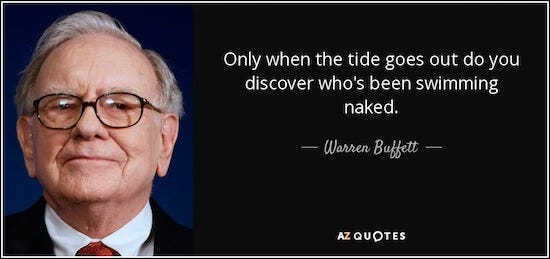
His call about the scale of investment required to build artificial intelligence could still prove correct. Unfortunately, when leverage is involved, being right isn’t enough. You have to remain solvent long enough to collect the payoff. Leopold made several unforced errors, which threatened his staying power. Once it was too late, the sharks knew he was ripe for the picking.
Ken Griffin Plays Hardball
Ken Griffin has been a major player in the hedge fund world since before Leopold was born. One of Griffin’s favourite books is Hardball: Are You Playing to Play or Playing to Win? This is telling to the way he sees business.
Most people in tech subscribe to the Peter Thiel view on competition from his book Zero to One: Competition is for losers. Thiel isn’t anti-competition but he observes that competition benefits consumers but is often destructive to shareholder value. The most valuable businesses in history have exercised some form of monopoly therefore, founders should strive to build one ideally by creating such a strong technological and distributive advantage nobody can threaten them.
After reading Hardball, you might wonder if Thiel wrote Zero to One as his response. Hardball accepts competition as an inevitability. It doesn’t discuss monopoly businesses, instead looking at companies that successfully defeated competitors by what the authors call playing Hardball. There are a few ways a company can play Hardball, but they all require being hyper aware of what your competitors are doing, so you can figure out where you can attack them to take market share. These can be larger companies trying to shake off upstarts or smaller companies going after the market leader. Being a Hardball leader and company, means you exploit every legal advantage you have at your disposal. This means hitting the competition, usually with indirect attacks, that put them under pressure, while being ready to fend off any of their retaliations. Citadel was built for the Hardball world.
It’s not clear how personally involved Griffin was in the purchase of Situational Awareness’s equity portfolio. However, the transaction reflects the Hardball culture he created. Leopold had spent the previous two years attracting enormous attention to himself and his strategy. His returns inspired an army of professional and retail copycats to pile into the same AI infrastructure companies. The more crowded the trade became, the easier it was for Citadel and other sophisticated firms to understand what would happen if those stocks began falling.
Situational Awareness had large, highly visible positions, meaningful leverage and a relatively inexperienced manager. Citadel had the size advantage and decades of experience profiting from distressed situations. You could not design a more attractive hardball opportunity. When the margin call came, only a handful of funds could take such a big position on such short notice. In came Citadel buying the book at a 10% discount, instantly printing an easy couple of billion dollars.
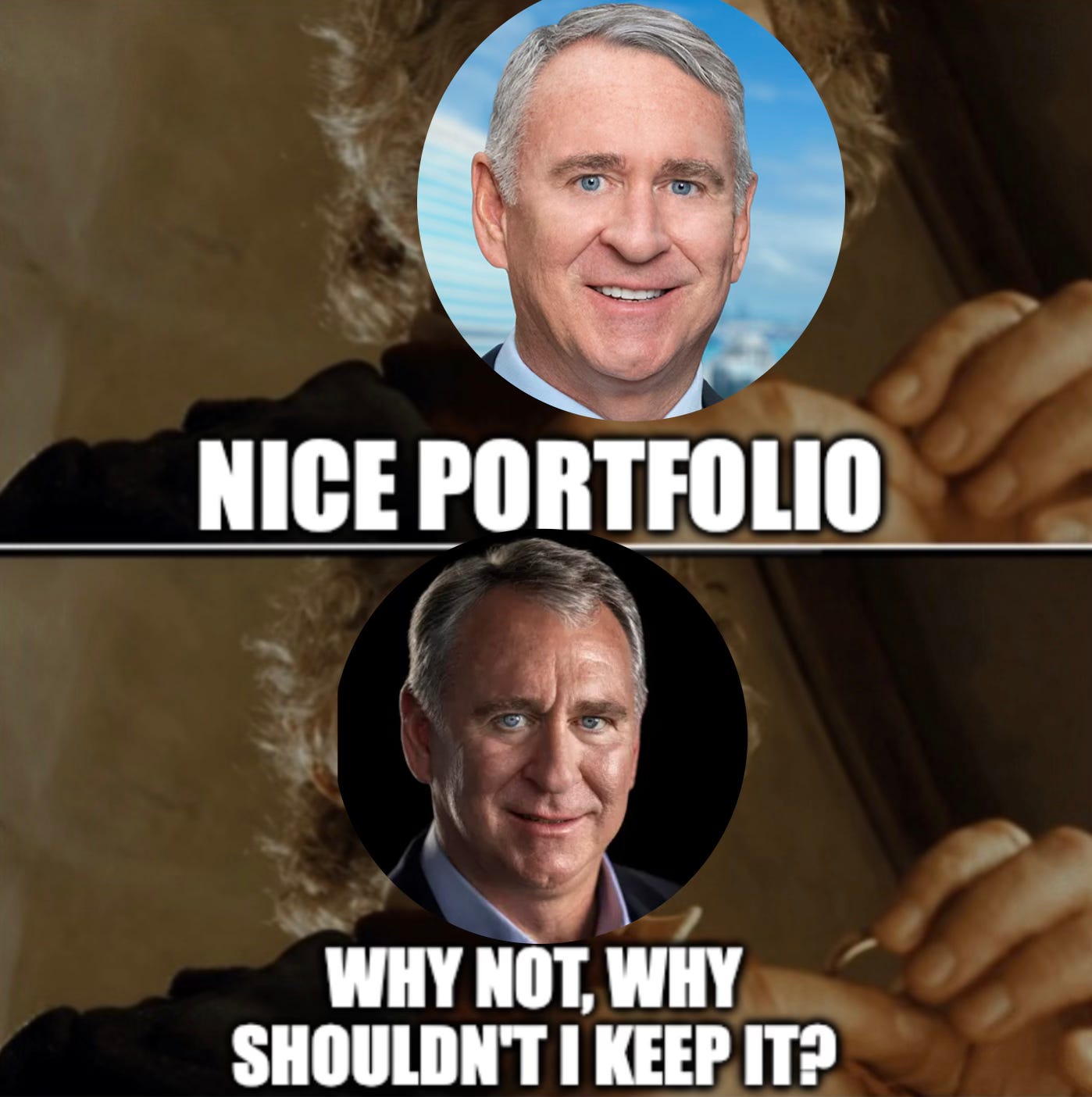
This is hardly the first time Citadel has mobilized quickly during a crisis. When Enron collapsed in 2001, Griffin chartered a plane and sent executives to recruit its energy traders. Situational Awareness was merely the latest distressed competitor to discover that Griffin is rarely sentimental when markets become chaotic.
Shortly before Citadel purchased the portfolio, Citadel Securities had publicly predicted that the Federal Reserve might surprise markets with an interest-rate increase. Higher rates would have been particularly damaging to the long-duration AI stocks Situational Awareness owned. Griffin wouldn't purposefully try to hurt an exposed competitor while they were already down would he?

(If you’ve made it this far, please settle a debate for me in the comments: Is a Beef Wellington considered a sandwich? (Yes/No and Why?))
Leopold is a new investor, he might be smart and right in the long term about his AI thesis but he structured his fund in such a way that it didn’t need a Black Swan event for him to get margin called. They claim to have hedges in place but the problem with hedging, is you can almost never perfectly hedge against every risk, if you do, it will come at the expense of returns. You can’t be doing 400% returns in 6 months while being perfectly hedged.
Trading on margin is commonplace, it’s done by most hedge funds and many retail investors, so is getting margin called. Over a million South Koreans got margin called in July alone. What’s notable is Leo flirted with liquidation while the S&P 500 is just off its all-time high. This wasn’t a market panic, this was sloppy fund management.


Situational Awareness was concentrated, leveraged and reliant on loose credit conditions to succeed. A bad month was inevitable. Leopold also overlooked that when you are trying to beat the market, you aren’t just going up against a passive index, you are competing with every other fund manager out there. Situational Awareness was exposed, and a Hardball competitor would not let that slide. The hedge fund world is full of Hardball players.
Despite an embarrassing episode, Leopold Aschenbrenner isn’t finished. While he had to sell off his public book, Situational Awareness still has a $5B stake in Anthropic. Leopold remains connected to many of the key players from the AI labs. Silicon Valley and he’s still at the very start of his career. Ray Dalio and countless other investing legends had trades go south on them early in their career and they were only the better for it.
He might have lost some of the boy wonder aura but people have short memories. Masayoshi Son has lost his fortunate and rebuilt it multiple times. Aschenbrenner might have prematurely claimed to have been gifted with situational awareness, but that does not mean he can’t eventually become one of the best investors of his generation. It just takes more than a coronation from CNBC for it to be true.
Thank you for reading. If you liked this article please Like, Comment and Subscribe below.