

Friday was my last day.
After 3.5 years with the company, I resigned on September 30th. There was no dramatic reason, I had simply decided it was time.
As people within the organization learnt of the news, the general reaction was some combination of shock, sadness, and in a few isolated cases, a slight hint of jealousy. Yet none of this resulted in candlelight sigils or hour long moments of silence.
It’s understandable, although I had been with the company since its early days, it’s only natural for people to reconsider their own standing when they learn of this kind of news. I’ve been in their shoes many times as colleagues have left, voluntarily or not. Before long people need to go back to focusing on their jobs.

As you read this week’s newsletter, I am now unemployed. I know what you are thinking and the answer is no. Unfortunately, I do not earn enough money from Serviceable Insights to retire. While I appreciate every one of my 1,000+ subscribers, none of you pay me anything, alas I will eventually need to find employment.
In the meantime, I hope new and existing readers enjoy this week’s article discussing the concept of a “career”. When did it start? What does the average career look like. Is loyalty rewarded or is it better to job hop?
Keep reading if you want to find out!
But first, make sure to hit the Subscribe button to join 1,000+ other Subscribers that get Serviceable Insights delivered directly to their inbox each week.
If this week’s article does not interest you, please check out some other recent ones:


What is a Career?
The sequence of jobs, roles, and professional experiences a person pursues over the course of their working life.
The concept is fairly new. For most of civilization most people were farmers, hunters or foragers. None of these roles came with much opportunity for advancement (Assistant to the Chief Forager?).
A handful were born into nobility, which had hierarchy and progressions, but promotions depended on birth order and waiting for someone ahead of you to die. Performance reviews weren’t a thing. If times were good, there wasn’t much to worry about besides gout or dying from a minor infection.
If times were bad, you might have been presiding over a war, an insurrection, or a barbarian invasion. In that case, your main concern was keeping your head but at least you didn’t have to sit through company downsizings.
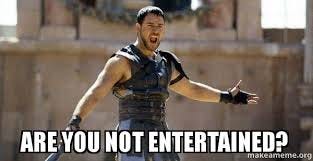
Most would assume dreaded conversations with the HR department only began during the Industrial Revolution but they started well before that. The army. New recruits, would begin similar to interns. First by training, or holding spears while real soldiers fought until it was their time to stab people. Except the cases when their armies were desperate so they were just thrown into battles without training or guidance. Similar to when startups can’t afford experienced people so they just take anyone willing to join.
If a soldier proved himself and didn’t die, he could climb the ranks and eventually call the shots. That is, until the new emperor got jealous and tried to have him killed by his own men, forcing him to fight for freedom in the gladiator pits.
While there was progression, the high chance of dying in battle made it difficult to make long term career plans. There wasn’t much possibility to change either. Perhaps they would occasionally change legions but I doubt the soldiers had a say.
Even once trades and guilds came around they provided more opportunity but they also restricted people’s ability to change careers (this is why Benjamin Franklin’s father left England for the United States). Therefore the notion of being able to freely pick and decide your own career or easily change likely only started, at least in western countries as late as the 18th century.
That’s when “careers” began: when the average person could have a self-directed, evolving journey across multiple roles or employers. I’m not saying they were good jobs, but for the first time, there was some semblance of choose your own adventure.
What Does The Average Modern Career Look Like?
It’s 2025, so I probably didn’t need to dedicate the opening section explaining what a career is. However, several of my Subscribers made a killing buying Crypto and Meme Stocks at the right time so they’ve never had to grapple with the concept of a job. For the rest of us though, our career plays a meaningful role in our existence; especially since we spend most waking hours during our prime years working.
With anywhere from 50-70% of high school graduates in the west going to university or some sort of trade school, most people start their careers in their early 20’s and retire in their mid sixties. At least that’s what the Boomers and Silent Generation got to do, us millennials and Gen Z will definitely be working into our seventies and eighties, to pay for their pensions and other government programs.
Given that careers span 30 to 50 years, my three-and-a-half-year stint at my firm will ultimately represent only 5% to 10% of my total working life. Still, since I’m only ten years into my career, it feels significant, and it is. The roles you take early on set the foundation for everything that follows.
Titles, growth, and trajectory matter less than the skills and networks you build in those early years. Those things matter especially for people with management ambitions. Only 10-15% of employees will ever reach the level of manager, and well below 1% will reach the executive level at any size company. This does not include people running banana or lemonade stands.
Several studies indicate salaries peak in a worker’s late forties to early fifties, then typically stagnate or decline until retirement. Outside of skills and education, the trajectory of salary growth can also be influenced by a young worker’s a) willingness to relocate and b) readiness to change jobs for higher wages or seniority.
This makes sense. In many cases, the longer someone stays at the same company, the more likely they are to become underpaid. Any company with an HR department will generally standardize pay scales, limiting what workers can earn relative to their seniority. It’s rare for a junior software developer to earn more than a senior developer, even if the junior is far superior. A senior can’t out-earn their manager, who can’t out-earn the VP of Engineering, who can’t out-earn the CTO etc.
Since only so many employees can be promoted, the net effect is that stronger employees at each level earn less than they should, while the beneficiaries are their relatively weaker colleagues or seniors. (I discussed this premise in Benchmarking is Lazy). As such, if you’re a strong employee who isn’t regularly getting promoted or receiving meaningful raises, at least 5% to 10% annually, you’ll likely find yourself getting paid much less than what you could earn elsewhere.
There’s plenty of data that confirms this. Job hoppers, people changing jobs every 1.5 to 3 years, earn on average 10% to 30% more than longer-tenured employees. I haven’t taken the time to review these studies in depth, but this aligns with anecdotal evidence, so let’s assume it’s true.
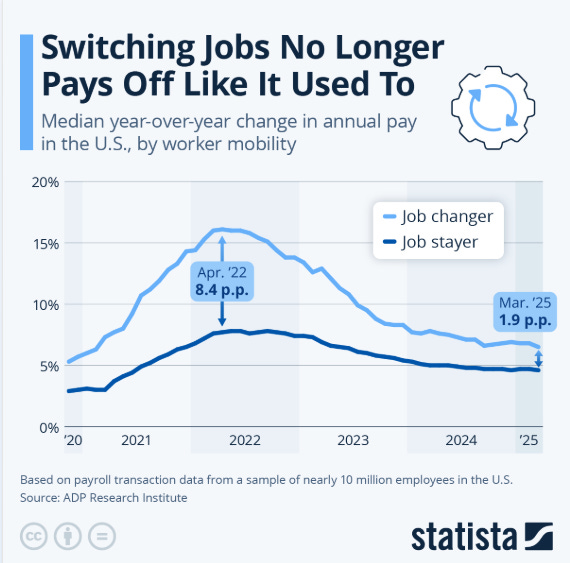
(Even a 2% difference in wage growth nets out to 22% after 10 years)
Therefore, this would imply to maximize career earnings, a worker should work at least seven-twelve companies before they reach forty. If you’re impatient, you can just pull a Soham Parekh, and work at four Y Combinator backed companies simultaneously.
This sounds nice in theory, but money isn’t everything (I apologize if this offends any of my maxi-capitalist readers). Even if you can consistently find companies willing to hire and pay you more, that approach treats your career like a hedonic treadmill you need to sprint through. Is it crazy to prioritize other factors, like enjoying your work environment, the mission, the people, or some combination of all the above?
At a certain point, lower pay starts bleeding into other aspects of your life, but endless job-hopping can do the same. Some people enjoy starting somewhere new every year, but changing jobs is among the most stressful life events. Up there with marriage and divorce, for good reason. Interviews offer limited visibility into what it’s actually like to work at a new company. You won’t realize what a nightmare your new company is until after you join. This shouldn’t be the reason to never leave a job either.
The right balance is finding an environment you enjoy that you feel pays fairly. This isn’t necessarily about work hours or prestige, it’s about supporting and aligning with your other life objectives. If it means working less hours to be more available to your family, taking a pay cut might make sense. If your personal burn rate is low, you have a lot of options. If your credit card statements look like a set piece from Home Alone 2, you have fewer.

Too much of the career conversation revolves around salary, seniority, and exit opportunities. Not enough attention is given to finding work that lets you enjoy both your job and your life. That might not maximize prestige or earnings, but careers last decades. If you have the chance to make your daily life meaningfully better, both inside and outside of work, you owe it to yourself to take it.
Careers are a relatively new concept. The freedom to change jobs and take chances is a modern luxury that most people throughout history never had. If you are fortunate enough to choose an environment that aligns with your values and goals, you should explore it. You may not find the perfect balance, but the pursuit itself is what makes a career worth having.
So here I am, between jobs, somewhere in the middle of my own “choose your own adventure.” Careers are no longer supposed to be a straight line. It’s a series of choices, chances, and the occasional leap of faith. This just happens to be one of mine.
Let’s see how this turns out, and if it doesn’t work perhaps I might need to start charging for these. Just kidding, Serviceable Insights will continue to operate as a reluctant non-profit for the foreseeable future, and I appreciate your non-monetary support.
Thank you for reading. If you liked this article please Subscribe below. I publish articles on a wide range of topics from business, books, current events or anything on my mind.
First, I hit like.
Then, I read.
The air of liberation must feel different, congrats on your new chapter!