
Have you ever opened your bank statement and started to sweat? It’s not a nice feeling to see you spent more money than you brought in. We’ve all been there though. Perhaps you needed to pay school tuition, emergency medical bill or something else essential. If the money is well spent, you should eventually be able to eventually pay it off, and keep these unpleasant feelings few and far between.
If you regularly blow money on trips to Las Vegas or things you see on TikTok, this is probably a common feeling. Assuming you still bother to look at your bank accounts. However, if you have some income and pay back even a small amount of your outstanding debt, financial institutions will be happy to extend you credit for a while. This does eventually run out though, especially when the economy starts to slow.
These days, governments look more like the person waking up from Vegas benders and TikTok shopping sprees. Even if they will both argue the money was well spent.
Since COVID public-debt burdens have surged to levels previously reserved for major wars. Advanced economies now routinely carry debt-to-GDP ratios exceeding 100 % or more; but continue to run major budget deficits with no end in sight. Emerging markets are also under pressure and their borrowing costs are rising.
The question looms: how will these countries get out of this debt? This isn’t the first time countries have gotten into debt trouble, how did they get out of it? In this article I examine the current debt situation, revisit the last era when debt was this bad (post-World-War II), analyze how countries got out of their financial trouble and what I expect will be the likely outcome.
Keep reading if you want to learn how Governments will get out of debt !
But first, make sure to hit the Subscribe button to join 1,000+ other Subscribers that get Serviceable Insights delivered directly to their inbox each week.
If this week’s article does not interest you, please check out some other recent ones:


The Current Debt Situation
It’s really bad. The longer the wait, the harder it will be to get out of it. Getting debt back to manageable levels will not be easy peezy lemon squeezy. It will be lemon difficult, difficult, difficult.
Virtually every advanced economy is carrying a massive debt burden and running meaningful deficits consistent with a prolonged war. You don’t need to be an economist to understand this a bad combination. Few politicians care. Austerity is unpopular, and it takes courage because even suggesting the notion can cost careers.
Look at France. Earlier this year, former Prime Minster François Bayrou, proposed a budget calling for substantial spending cuts (~€44 billion). France still would have ran a large deficit (5.4%), well above the EUs deficit limit of 3%, but at least it was lower than the 2024 budget (6.1%). His colleagues responded to his proposal with a motion of no-confidence. He lost and resigned. France has yet to pass an updated budget, meaning they will continue to with the an extension of the 2025 budget.
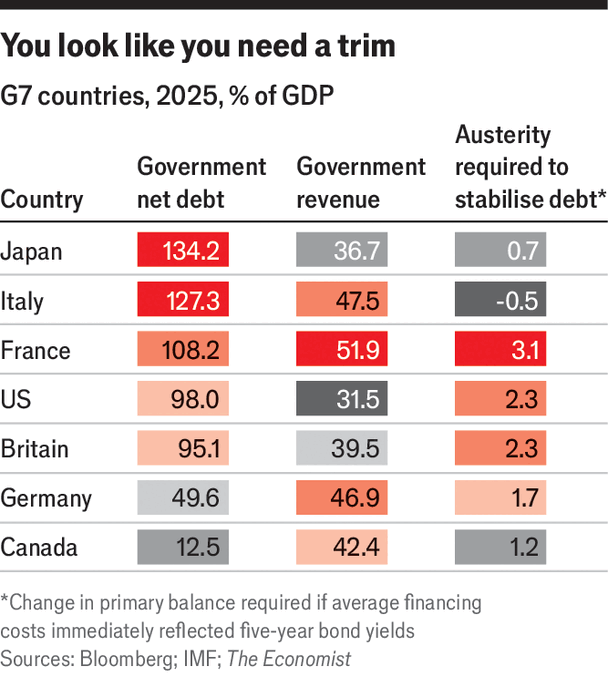
(Canadian net debt appears low because the major pension funds hold over a trillion dollars in assets)
The French aren’t alone in their reluctance to rein in deficit spending. The US is projected to run a deficit above 6% in 2025. Many European countries will exceed the 3% deficit limit. The emerging countries with lower deficits mostly do so because capital markets prevent them from borrowing more. This is a global problem.
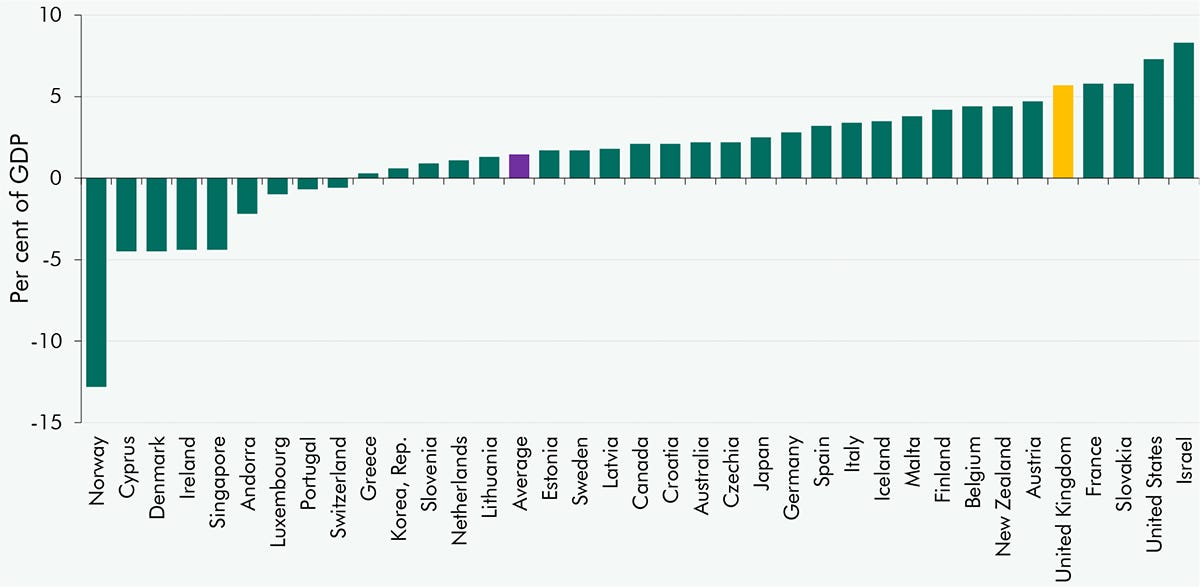
(This chart shows estimates for 2024 compiled mid-2025)
Advanced economies have previously carried public-debt to GDP ratios exceeding 200%, but this was usually after events such as WWII. The current debt was used not for war, but for stimulus after The Great Financial Crisis and COVID-19. The low interest rate regime throughout this stretch masked the budgetary burden, but as debt levels and rates have risen, so has interest service costs. Now interest payments on this debt are becoming one of the biggest line item, on par with military/defense, healthcare, social security/retirement pensions, costs people care a lot about.
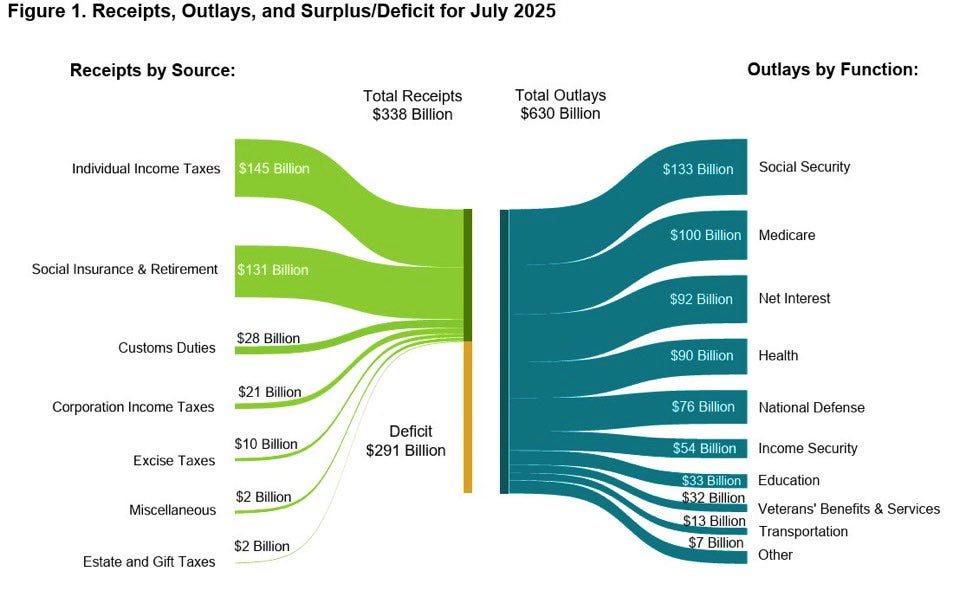
(This is for the US as of July 2025)
This has been a growing problem for years politicians have tried to ignore or dismiss. Perhaps they can continue with this approach for longer but without some eventual intervention, it won’t be long before major economies enter a debt burden trap, they won’t be able to get out of. This won’t be a country like Greece or Venezuela, this could be multiple G8 countries.
This prompts the question, how have countries previously gotten out of major debts?
What has Worked Before?
After WWII, government debt in advanced economies reached levels that make today’s numbers look like child’s play. In the UK, public debt peaked at roughly 270% of GDP in 1946. By 1971, it had fallen to about 50 percent. The US followed a similar trajectory. American government debt was about 106% of GDP in 1946, but by 1974 it was down to 23 percent.
Modern politicians willing to acknowledge the matter, target “waste.” Elon Musk and DOGE style efficiency campaigns argue that cutting bureaucratic fat can save billions. Maybe so, but even the most generous estimates of their efforts were drowned out by the trillions poured into tax cuts, subsidies, and new spending. Since President Trump began his second term, the deficit has gotten bigger, not smaller.
Argentina proved the same point from the opposite angle. President Milei slashed spending aggressively and still needed a bailout. Cutting spending helps, but it can’t solve debt problems alone.

Even left-leaning governments now pay lip service to waste reduction. In the 2025 Canadian budget, the Carney led Liberal government committed to reduce government spending by tens of billions over the next few years yet they still project a much larger deficit ($78B CAD) than the proposal that got Trudeau ousted last year.
Efficiency is useful, but it can’t fix a structural problem. Most government budgets are tied to programs that cannot be touched without major political fights. Social Security, Medicare, Veterans Affairs, and interest payments make up most of US federal spending. Many countries face similar constraints. Cost reductions can help trim the edges, but strong growth is needed to run sustained surpluses to shrink debt.
The bigger issue is that spending cuts reduce economic activity unless the private sector steps in. That rarely happens on its own. It usually requires new incentives, easier credit, or technological breakthroughs that open new investment opportunities. This was the real engine between 1945 and 1975.
As wartime budgets unwound, government spending as a share of GDP fell sharply. About 38% lower in the US and 30% lower in the UK. Wars are expensive. Avoiding them is the best austerity there is. Redirecting money from weapons toward housing, highways, and education built a much stronger foundation for growth.
Policy helped too. The US passed the Employment Act of 1946, invested heavily in infrastructure, and lifted wartime price controls so markets could function normally. The UK nationalized key industries, created the National Health Service, expanded public education, and phased out rationing.
They also benefited from low real interest rates. Treasury yields stayed below inflation, which quietly reduced the real value of outstanding debt. In 1971, the US ended the gold standard, which gave policymakers more room to manage the economy. Of course, that eventually led to rampant inflation, but that was after.
Most importantly, postwar growth stayed strong. Once the war ended, the US shifted from 10% annual growth to a steady 3-4%. Since growth stayed above the cost of interest, the debt burden became easier to carry. Debt to GDP fell even though the debt kept rising. Ray Dalio refers to this as the beautiful deleveraging (his piece last week touches on some of these points). That relationship is why many economists argue that debt levels only become dangerous when interest rates rise above long term growth. This is one of the reasons central banks get heavily criticized when they try to raise rates. With the current debt levels, even a slight increase in the cost of debt has major budget implications.
The lesson form history, is that spending cuts alone don’t bring down debt. That can only happen when spending grows more slowly than the economy itself. That requires low real rates, steady inflation, and a private sector strong enough to replace emergency era government spending.
What Is Likely To Happen Now
Countries will attempt to solve the debt problem in different ways, but almost all of them rely on the same basic formula. They want strong GDP growth and low interest rates. Technologically advanced economies such as the United States and China are pouring public and private money into AI, data centers, energy infrastructure, and the minerals and manufacturing that support them. China has been building these supply chains for years. Other countries are trying to catch up.
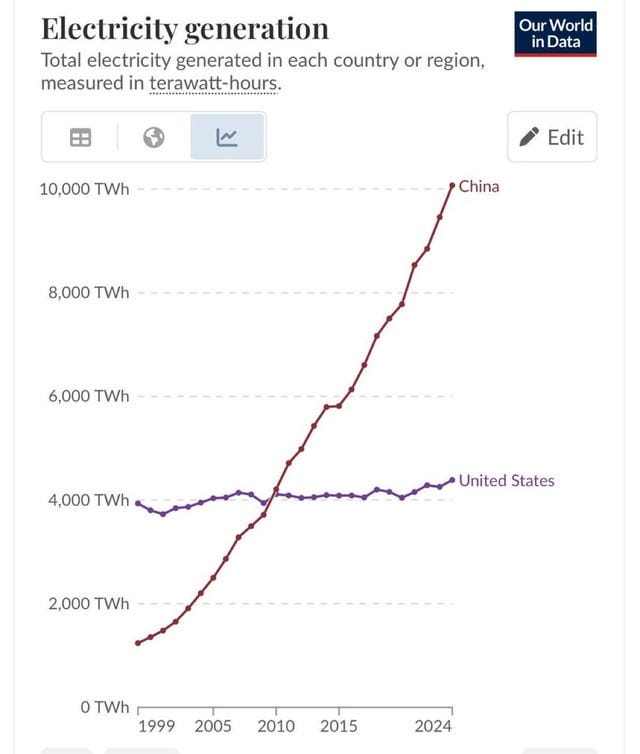
Stock prices and venture funding announcements do not matter unless all this investment eventually turns into higher productivity and higher GDP. After the internet boom of the 1990s, the United States experienced rapid economic expansion, which helped produce its first budget surplus in decades. That surge was not driven by technology alone. The political gridlock of the era forced fiscal discipline, globalization expanded, the Cold War ended, and the country enjoyed several powerful economic tailwinds.
The debt trajectory reversed when the Bush administration financed the War on Terror and later responded to the Great Financial Crisis with large deficits. The Obama administration continued the pattern. Other countries followed a similar path. Cloud computing, smartphones, and social media boosted productivity, but not enough to offset the scale of government spending. With birth rates declining and aging populations, developed countries leaned on higher immigration to keep their labor forces stable. This approach did not generate enough growth to close the gap, and public support for immigration has since weakened. With immigration decelerating, a smaller working population will need to support a larger base of retirees and debt obligations.
These debt levels will rise. These deficits ensure that the outstanding debt keeps climbing. Many of the investments that might raise growth could take decades to pay off. For this to improve the situation, nominal GDP growth needs to exceed interest costs + primary government deficit. For the US and the average OECD country, this threshold is roughly 5-8%. Today, nominal GDP growth sits closer to 3-6%. Sustaining growth above 6% is extremely rare in peacetime. Eventually, deficits have to shrink or inflation has to rise to achieve this reduction.
Unlike post WWII, many countries didn’t have the same pension commitments and universal healthcare coverage. These line items by default make up a large part of the countries budget, anywhere from 10-25% of GDP across the OECD, and are difficult to change. Realistically, retirement ages will need to be pushed back, but this is always met with very hostile opposition from unions and left leaning parties. Healthcare is another main cost which will only rise as the aging population requires more medical attention. Unless humanoid robots and Chat GPT can treat all of these patients, it will be difficult to reduce costs. Canada’s creative solution is to encourage people to die but I’m cautiously pessimistic this will solve the problem. Therefore with higher medical costs, pension contributions unlikely to come down, the options are to try to cut other government programs, find a way to raise taxes without stifling growth or have the money printer go BRRRRRR.
The likely outcome is a mix of everything above. Governments will trim a few programs, then spend the savings somewhere else. Tax revenue will rise, but not because anyone raises tax rates. Inflation pushes salaries higher, which quietly moves people into higher tax brackets even as their purchasing power falls. The same happens with property taxes. When home prices climb on paper, governments collect more revenue even if nothing about the tax rate changes.
None of this will be enough to fix the gap, so policymakers will lean on a familiar tool. They will allow inflation to run hotter than they admit. They will try to avoid the double-digit mistakes of the 1970s and 1980s, but history suggests they will slip at some point. It might not happen this decade or the next, but it is almost inevitable.
The net effect is simple. Expect higher deficits and higher inflation for a long time. If we are lucky, this combination will gently push debt-to-GDP ratios down. While the ratio will improve, the actual debt levels will not actually decrease; they will continue to climb just at a slower rate than nominal GDP grows. This is because countries don’t repay their debts like people or companies, they continue to roll them over indefinitely, putting these obligations on future generations.
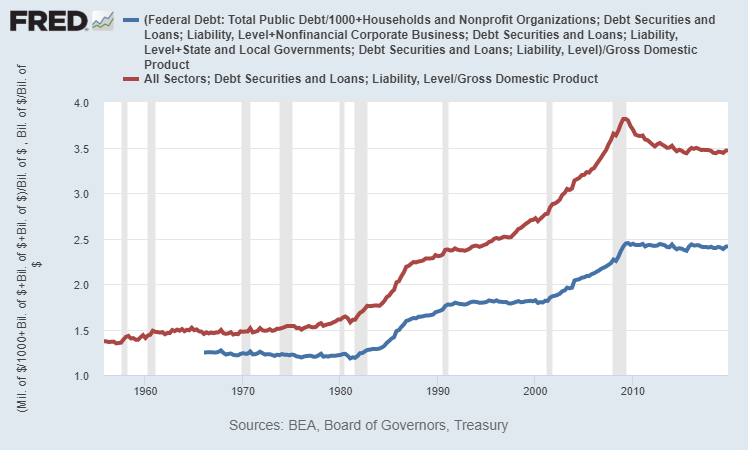
This is how countries will unwind their debt problems. In the same way they created them in the first place. Nothing really changes.
(If this topic is of interest to you, I suggest you check out Big Debt Crises by Ray Dalio)
(Here is a great article by Michael W. Green of the dangers of these policies and the quiet cost of inflation)
Thank you for reading. If you liked this article please Subscribe below. I publish articles on a wide range of topics from business, books, current events or anything on my mind.
I largely agree, Ben. In the end it will be inflation.