

After cycling through every status symbol money can buy, we have ended up back where the ancients started.
Plato argued that what people truly wanted was not pleasure or wealth, but to live forever. Not literal immortality, but a life that refused to disappear. Achilles embodied this by choosing to die young as legend at the Battle of Troy instead of living a long but uneventful life.
Somewhere along the way, people have gotten Plato backwards; they want to live forever but avoid doing anything consequential that might mess up their sleep score.
Instead of listening to old wise men, this generation prefers to listen to middle-aged dudes with podcasts. This has fueled explosive growth of interest in health & fitness content targeted at longevity.
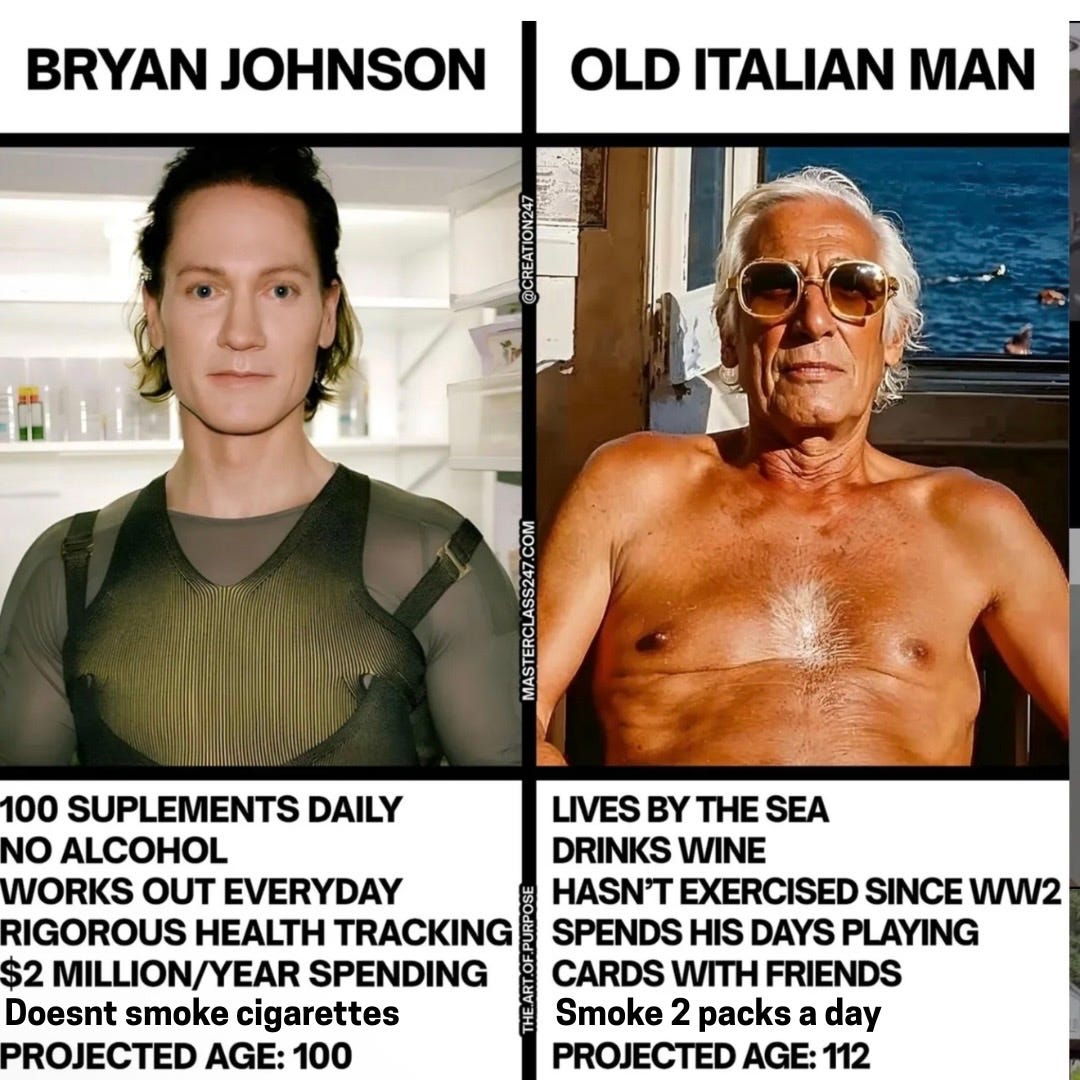
Bryan Johnson went from obscure exited tech founder, to the leader of an online cult of longevity obsessed folks. He’s not alone. Not long ago, Peter Attia was unknown outside of fitness circles, now he hangs out with people like Chris Hemsworth. Thor himself has produced two seasons of longevity content with the Discovery channel. These fine folks have inspired countless fitness bros and girlies to stop drinking, spend hours in the sauna, jump in cold plunges, wear red light masks and count their night time erections.
Although I doubt any of this will help you outlive the average old Mediterranean dude hanging around the cafe all with his friends all day, I have tested many of these methods and have some sense of what I’m talking about. Maybe not enough to start a podcast but perhaps one day with your help.
As a lifelong fitness enthusiast and former personal trainer now working in a white collar career, I represent the perfect target demographic for this stuff. I started looking into many of these things before Bryan Johnson came on the scene. A decade ago at the start of my finance career, I researched health and fitness tech startups (remember Fitbit?) which required learning about many of these treatments.
There were plenty of scams that never took off, but some endured and are even thriving to this day. After I stopped working in the industry, my health and fitness passion endured; I read all the books and consumed too much of the content. What follows is my take on which longevity strategies are worth your time and which are probably just expensive ways to feel in control of death.
If you missed my previous pieces on Barry’s Bootcamp style workouts and Pilates, check them out, otherwise keep reading if you want to learn how you might be able to live a longer and healthier life!
If this week’s article does not interest you, please check out some other recent ones:



Table of Contents
Before getting into specifics, it’s worth drawing a basic distinction between lifespan and healthspan. The goal is not to live as long as possible at any cost. Living to one hundred while spending the final decades immobile, medicated, and tethered to machines is not a win. The real objective is to move, think, and live like you are in your forties or fifties for as long as possible.
Biohacks do not override bad fundamentals. No supplement, sauna protocol, or wearable can compensate for consistently poor sleep, inactivity, or a diet built around ultra-processed food.
More than 80% of the outcome can be explained by eating less garbage, moving regularly, and getting enough sleep. What follows is a practical breakdown of what has mattered most for me, separated into three sections::
Fitness
Nutrition & Auxiliary
Fitness
When it comes to longevity, a few things matter. Strength, maintaining muscle mass, cardiovascular health and mobility. Without intervention all will atrophy over the time, which is why your workout program needs to address them. To be reductionist, if you don’t use it, you will lose it.
To ensure you are set up for longevity success, you need to at least hit the minimum effective dose (MED) for each area. If you have capacity, ideally you do more. Since your body will adapt, the frequency and volume will change over time.
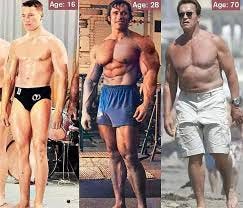
Beginners start from a low base and usually see rapid improvement, but if they lack consistency, they will cede these gains almost immediately. Experienced folks progress and atrophy at a much slower rate. Once you reach a certain level of fitness, you can train less without getting out of shape. This is why the earlier you start training, the easier it is to stay fit for life. Just look at Arnold.
If Brian Shaw, 43, the former worlds strongest man didn’t exercise again for the rest of his life, he would still be stronger than 99% of the population because he’s starting from such a high base. If you wait until you retire, you face a steep uphill climb.
(Last January I published some tips and evergreen fitness advice, I suggest you check them out if you haven’t already.)
Fitness Biohack # 1 — Only Meatheads Train To Failure*
The key is consistency over intensity. Prolonged layoffs are difficult to bounce back from, especially as you age, so your goal should be to train hard but in a smart way to minimize the chance of injury. Think in terms of risk versus reward. If you are training until failure on every set, I promise, you will eventually get injured. Only loud broccoli haired teenagers think this is smart.
If you never fail during a set, you aren’t pushing yourself hard enough. You need to occasionally test your limit but in general, you should leave 1-2 reps in reserve on every set. Plenty of research shows the incremental difference between that and failure is negligible but it brings down your injury risk dramatically.
Each time you train, add weight or reps to your exercises. Some days you aren’t going to be able to, but if you want your get stronger or add muscle mass, you need to follow the progressive overload principle.
If you find yourself stalling out on a particular exercise, don’t be discouraged. It’s normal to adapt to your training regiment over time. Step away from an exercise for a few weeks, try different variations. You might be surprised to see the improvement returns when you pick it back. Your goal is to get stronger, not just move more weight on a particular exercise. I stopped bench pressing for years but continued to train other presses. After picking them back up, it only took a month, benching once per week, to establish multiple personal records (PRs).
For a MED training regiment, hit every major muscle group (Chest, Shoulders, Back, Quadriceps, Hamstrings & Core) at least once per week. Starting out one-two sets will be enough to see progress, but eventually you’ll need to up this to 4-5 or more. I do around 80 working sets per week but only fail at most 4-5 times. On these failure sets, I make sure these exercises are failure safe (Belt Squats, Chin ups etc.) or I have a spotter to step in. If you are failing on every deadlift rep don’t invest too much time researching longevity.
Fitness Biohack # 2 — HiiT Yourself Out of Sleep Deprivation
After a bad night of sleep it’s tempting to skip the gym or go easy. If your goal is to shake off your fatigue, you should actually dial up the intensity.
This isn’t a David Goggins mantra, research shows that a High Intensity Interval Training (HIIT) session can help offset the effects of sleep deprivation. I first heard Dr. Rhoda Patrick mention it on her podcast and I was skeptical. She’s great, but not all of her claims, even if backed by scientific research, work when you try them.
This one really does though. There are definitely limits to this, so don’t think HIIT will save you after a 3 day bender but I’ve used this many times to great success.
After sleeping between 4-6 hours, I’ve woken up tired but after a short HIIT session followed by a cold shower, the fatigue effect disappeared for up to 12 hours. I would still take coffee but the difference of trying just coffee versus HIIT + Coffee or HIIT + no coffee was undeniable.
There’s a few different ways you can do HIIT training. A popular method is the Tabata (see below) but you can play around with work to rest ratios as needed. What matters is that you are able to go hard or all out on each sprint because the rest period gives you a chance to replenish slightly.
HIITs are my primary method of cardiovascular training and I do them many ways but here are some of my favorite ways:
Assault Bike Tabata 20 Seconds On, 10 Seconds Off 8 Times (this counts as one set). I usually do 1 or 2 sets at the end of a workout with a few minutes break in between. This is a work to rest ratio of 2 to 1. You can also do 30 seconds on, 15 seconds off, 60 seconds on, 30 seconds off etc. If your cardio is good, your legs will likely be the limiting factor on the assault bike. You can do this on the treadmill, rowing machine, any cardio machine of your choice.
250 meters rowing machine followed by 250 meters on the curve treadmill:
I usually do 3-4 sets also at the end of the workout, or in conjunction with other cardio sets. My goal is for the combined time to be between 1:40 - 2 mins for each set and I’ll usually take 1-2 minutes rest between each set. This is to get a work to rest ratio of 1-1 or 2-1.
0.3 Miles on Assault Bike or 200 M Ski ERG followed by 200M on the curve treadmill: Like the others, I normally do 3-4 sets at the end of a workout or in conjunction with other cardio. If I do skiier, I don’t take any break between sets (I just rotate between skiier and treadmill), if I do assault bike I take a bout a minute to 90 seconds rest between sets.
There are endless combinations you can follow.
Fitness Biohack # 3 — Zone 2 Cardio is Overrated
If you listen to any longevity fitness guru they will not shut up about aerobic fitness/Zone 2 training. They cite exercise science journals espousing the benefits of Zone 2 cardio that includes:
Targeting the mitochondria
Improving insulin sensitivity
Lowers fasting glucose and triglycerides
Improves metabolic flexibility (switching between carbs and fat)
Reduces visceral fat preferentially
All good stuff. Going back to risk versus reward, the cortisol response is less than the other zones and the recovery cost is low. None of this is particularly disputed or controversial. So why is it overrated?
Zone 2 works, but it’s inefficient from a time perspective. Most of the metabolic and cardiovascular benefits attributed to Zone 2 can be achieved through higher-intensity Zone 3-5 work in a fraction of the time. You can run slowly for 40 minutes or run fast for 5 to 10 minutes. If you are pressed for time, what makes more sense?
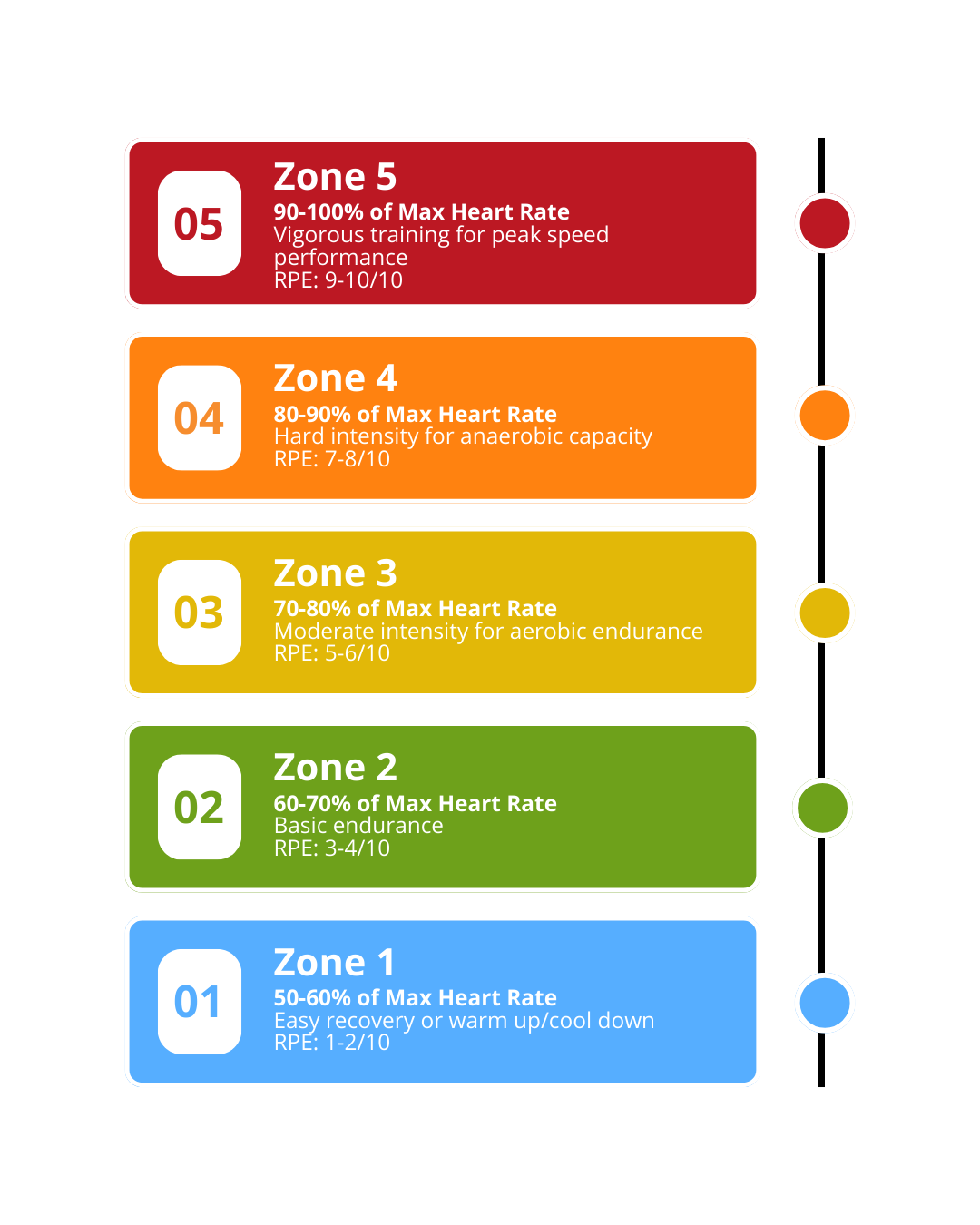
Zones 3 through 5 impose greater acute stress, particularly on the nervous system, so you can’t do it every day, but you don’t need to for it to be effective. Longevity is about reliably hitting the minimum effective dose across systems. Most people have to choose how to allocate their limited training time. Over-allocating to aerobic training will hurt your longevity goals if it comes at the expense of other areas of fitness.
When it comes to injury, high intensity work is framed as dangerous while Zone 2 is treated as safe. This conflates heart rate zone with mechanical stress. Running for 40 minutes on pavement puts impact on your feet, knees, hips, and ankles regardless of intensity. Way more than short high-output intervals on the stationary bikes, sleds or rowing machine.
Training at a higher intensity can carry over to the aerobic system, but Zone 2 training won’t make you explosive. I’m not the only one to think that. Mike Boyle of Mike Boyle Strength & Conditioning, has been saying this for close 20 years that aerobic training is misapplied or overdone.
If you have the time for it, Zone 2 is great. You can get all the benefits through low impact activities such as swimming, biking or Stairmaster for an hour with minimal injury risk. Most people don’t have unlimited time and will need to find a way to squeeze in strength training, stretching, and everything else in their life. With 5 to 15 minutes at the end of a workout, interval-style training can touch Zones 2 through 5 and capture much of the same longevity-relevant benefit at a far lower time cost. If you aren’t new to training and you’re only working out a few times per week, the risk of over taxing your CNS this way is low.
Many of these studies about the harm of training above Zone 2 are on the untrained, elderly, or the metabolically unhealthy. If you don’t fall into these categories and don’t train cardio every day you shouldn’t be overly worried. Keep in mind, as your cardiovascular fitness improves, it takes more effort to leave Zone 2. While you are doing interval training, you’ll spend more time in Zones 2 and 3 than you realize, because the perceived effort is much higher than your heart rate would imply.
(After finish writing this article, I noticed Peter Attia tackled the same subject on his blog last week. Tldr, he’s not ready to abandon Zone 2).
Nutrition
Ray Kurzweil and Bryan Johnson take hundreds of pills each day. They believe in their protocol but this is unnecessary for the average person. It might improve things at the margins but if you don’t have any pre-existing health problems you shouldn’t worry about that, perhaps until much later in life. The only supplements I take are Creatine and Omega-3. I wrote about my experience with creatine in depth here.
What you don’t consume matters more, you solve a lot of problems by avoiding smoking, drugs, over eating, especially sugar, ultra-processed foods and alcohol amongst other things.
Nutrition & Auxiliary Biohack # 1 — Stop Drinking*
If you don’t think consuming large amounts of alcohol negatively impacts your health over time, I won’t try to convince you otherwise.
I already did an article about my experience stopping drinking. Check it out if you haven’t but to summarize, it does help but I didn’t see a noticeable difference going from 1-2 drinks per week to zero.

Of course after a night of heavy drinking, your sleep will suffer and you’ll be badly dehydrated but if these evenings are infrequent and far between, I am not convinced this has a meaningful impact on your longevity.
I’ve worn a Whoop band consistently for over a year, and alcohol has not shown a profound effect when viewed over weeks or months. The day after drinking, yes. When you zoom out, not really. This assumes you are actually having one or two drinks per week, not six to ten.
For most people, a single drink with food five to six hours before sleep should not materially affect sleep quality, especially if hydration is adequate. A nightcap is a different story and almost always shows up negatively.
For some people, moderation is harder than abstinence. Cutting alcohol out completely can be simpler, and there is nothing wrong with that. But an occasional glass of wine with friends will not shave years off your life. I had two the other night and still woke up with a 97 percent recovery score.
If you are drinking more than two or three times per week, you would almost certainly benefit from cutting back. Beyond that point, the returns diminish quickly.
Nutrition & Auxiliary Biohack # 2 — Sauna & Cold Plunges
Even if you haven’t been following Johnson, Attia, Patrick or Huberman, you’ve undoubtedly heard everyone rave about the miracle effects of using the sauna and cold plunge. Concepts such as Othership charge hundreds of dollars for people to sit in cold tubs with strangers. You might be wondering how this is different from a spa, and that’s a good question. It’s not. These are just more culty spas where instead of going to relax, people yell and hyperventilate.
Saunas and cold water exposure aren’t new. Saunas have been a staple of Nordic culture for centuries, and even relatively affordable gyms like the YMCA have offered them for decades. Unlike many modern wellness trends, sauna use actually has a meaningful body of research behind it. Regular sauna use is associated with:
Lower all cause mortality and lower risk of heart related deaths
Reduced systemic inflammation
Improved cardiovascular health and insulin sensitivity
Lower risk of developing type 2 diabetes, dementia, and Alzheimer’s disease
Induction of heat shock proteins, which support protein repair, cellular stress resistance, and autophagy (more on that below)
Lower rates of depression and reduced muscle soreness
Read naively, the conclusion sounds simple. Sit in a sauna a few times a week and dramatically extend your lifespan and fix all of your problems.

(Your experience sitting in a 200F Sauna may differ)
I’ve personally used the sauna almost every day for the past three years after training. Subjectively, I feel great afterward. However, from a recovery standpoint, Whoop shows little to no meaningful impact. That could be a limitation of Whoop, but it does seem to conflict with parts of the scientific literature.
Bryan Johnson put out a recent video where he outlines the effects he saw after 90 days. He saw many of these improvements and he’s already in the top of the longevity protocol training.
One of the major problems with interpreting results like this is overlap. Training, sleep, diet, stress management, and sauna use all move the same biomarkers in similar directions. Without controlled conditions and expensive testing, it’s hard to attribute causality to any single input. I don’t have access to the same measurement tools Bryan does, so I can’t isolate what protocols are responsible.
Cold plunges, on the other hand, show a much more obvious signal.
Part of this may be explained by frequency. I don’t cold plunge daily and often substitute cold showers, which are meaningfully less effective. Still, whenever I do a proper cold plunge, Whoop consistently shows dramatic recovery effects. Lower resting heart rate, reduced inflammation, and higher heart rate variability. These changes line up closely with what the research would predict from acute cold exposure.

One important caveat is timing. Cold plunging immediately after strength training does appear to blunt hypertrophy and strength gains. I can confirm this from both the literature and personal experience. Some people extend this claim to cold showers, but I have not seen the same effect there. If you are going to cold plunge, you should do it before or a few hours after training if you don’t want it to interfere with strength gains.
Nutrition & Auxiliary Biohack # 3 — Fasting
For more than three years I did 3 day water fasts every couple of months. This was after reading a few books by David Sinclair, Valter Longo and others. Johnson and Attia weren’t talking publicly about longevity yet.
There are several benefits associated with prolonged fasting including:
Autophagy activation
Prolonged fasting increases cellular recycling and cleanup pathways (autophagy), which may improve cellular resilience and removal of damaged proteinsRapid metabolic reset
Extended fasting sharply lowers insulin levels, increases insulin sensitivity, and accelerates the shift to fat and ketone metabolism, which can temporarily improve metabolic markers in insulin-resistant individuals.Inflammation and immune modulation
Blood pressure and cardiometabolic markers
You begin to see some of these processes after roughly 12 hours without food, but they don’t become meaningful until closer to the 36–48 hour mark. Autophagy, in particular, appears to increase more substantially after about 48 hours, which is why multi-day fasts are often cited by proponents as the “real” intervention.
If you aren’t a constant snacker, the first 12-18 hours should pass by without too much difficulty, it’s the 24-36 hour mark that’s the most difficult. Your body is expecting to have consumed a few meals by now, and will remind you that you’re missing out. Once you get past that 36-40 hour mark, your body sullenly accepts food isn’t coming and the feelings of hunger will usually subside. Once you reach this point, you can make it to 3, 4 or even 5 days. A key factor is going to be cortisol. It’s going to rise quite a bit, especially in the early days, since it usually declines with eating. If you go into a fast with already high levels, it’s going to feel more difficult.
In my case, I can go through 3 days with relative ease. The difficult part isn’t dealing with the hunger, it’s avoiding social occasions, especially if your partner decides to make pasta Bolognese while you’re deep into a fast.
As long as you keep yourself distracted, the fast goes by quickly. In my case, I still workout and do sauna during my fast, but dial back the intensity or do less cardio. If you try it, make sure to have salt, it can be dangerous to exercise intensely while fasting. If it’s your first time fasting, probably skip the workout and try walking instead. Don’t take my word for it, I don’t know your health situation, talk to your physician or do some of your own research before fasting.
Last year, I noticed fasting this often caused me to lose too much muscle. I would drop ~10-12 pounds after each fast, 5-6 lbs would come back within a couple of days but the rest was muscle, which takes longer to build back. I would basically just be regaining the muscle back in time for the next fast. This was starting to hurt my strength gains in the gym and brought down my weight, so I haven’t fasted in the past year. I will continue to do them, but probably only max once per year. Peter Attia had a similar observation and reflection.
Did I notice any of these effects? Not really. I didn’t have way to test them. You feel like things are happening during the fast and assuming you break the fast in a smart way, you definitely feel different sensations for a day or two after but you eventually return to baseline. If you are generally pretty healthy to begin with, this seems like another hack that probably only offers marginal benefit and it’s debatable if it’s worth the inconvenience. Part of the problem, is I already get many autophagy benefits from working out, sauna and other activities and it’s difficult to isolate what’s responsible.
This is the recurring problem with longevity culture. Every protocol forces tradeoffs, and no one has unlimited time or attention. Trying to optimize everything means enjoying nothing. Health matters but it’s a means, not an end. If your entire life becomes a series of rituals designed to extend it, you’ve already missed the point. Eat well. Move. Sleep. Maintain friendships. Do things that feel worth staying alive for. Achilles understood that a long life without meaning isn’t immortality. It’s a delay. Your goal should be to live with Achilles-level intention for as long as you can.

Thank you for reading. If you liked this article please Subscribe below. I publish articles on a wide range of topics from business, books, current events or anything on my mind.
Bryan Johnson is on Substack. If you want his perspective, here is his latest article.
Luv this line! "If your entire life becomes a series of rituals designed to extend it, you’ve already missed the point".
Great reminder to use the body n not just preserve it. Somehow reminded of Buffett’s line about working at a job one hates just to build a pretty cv " like saving up s*x for old age"..
Every benefit I read about for fasting you can induce much more quickly via exercise. Or ketosis.
If you’re overweight or sedentary? Absolutely go for it. Going in to ketosis certainly has benefits.