

Most people outside of the finance world have no idea what private credit is.
It’s not surprising. Nobody knew what Mortgage Backed Securities (MBS), CDOs and CLOs were until Bear Stearns, Lehman Brothers, Fannie Mae and others collapsed.
Nobody really cared. The housing market was growing, there were conflicts in the Middle East and it was good couple years for films.

The immediate response to the Great Financial Crises (GFC) 2008, was for the Treasury and Federal Reserve provide massive stimulus and slash interest rates among other measures to stabilize the economy.
Later regulators imposed new guardrails to prevent a similar collapse in the future. In the US, they passed Dodd-Frank (2010), internationally there was Basel III, the net effect was they made it more difficult for banks to lend.
Naturally with near zero interest rates for over a decade, investors were seeking a higher yield and there was no shortage of people looking to borrow. They couldn’t go to banks so they looked elsewhere. Capital market investors filled this void.
These are private equity, credit firms, hedge funds, specialized vehicles including Business Development Corporations (BDCs) (more on those later). The net effect is lending from these institutions grew from $300 billion to $3.5 trillion from 2010 to 2025. This growth has not gone unnoticed.
Private credit has been in the headlines a lot in the past year, but not for good reasons. Many private credit funds or BDCs have come under pressure in recent months, some seeing their share prices plummet >30% since the start of the year.
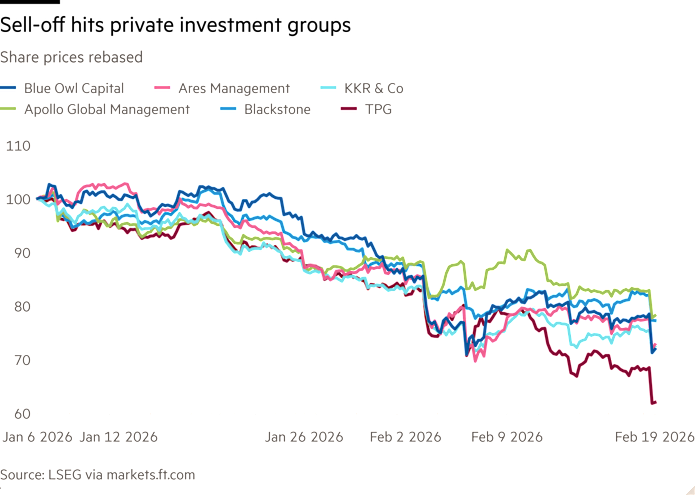
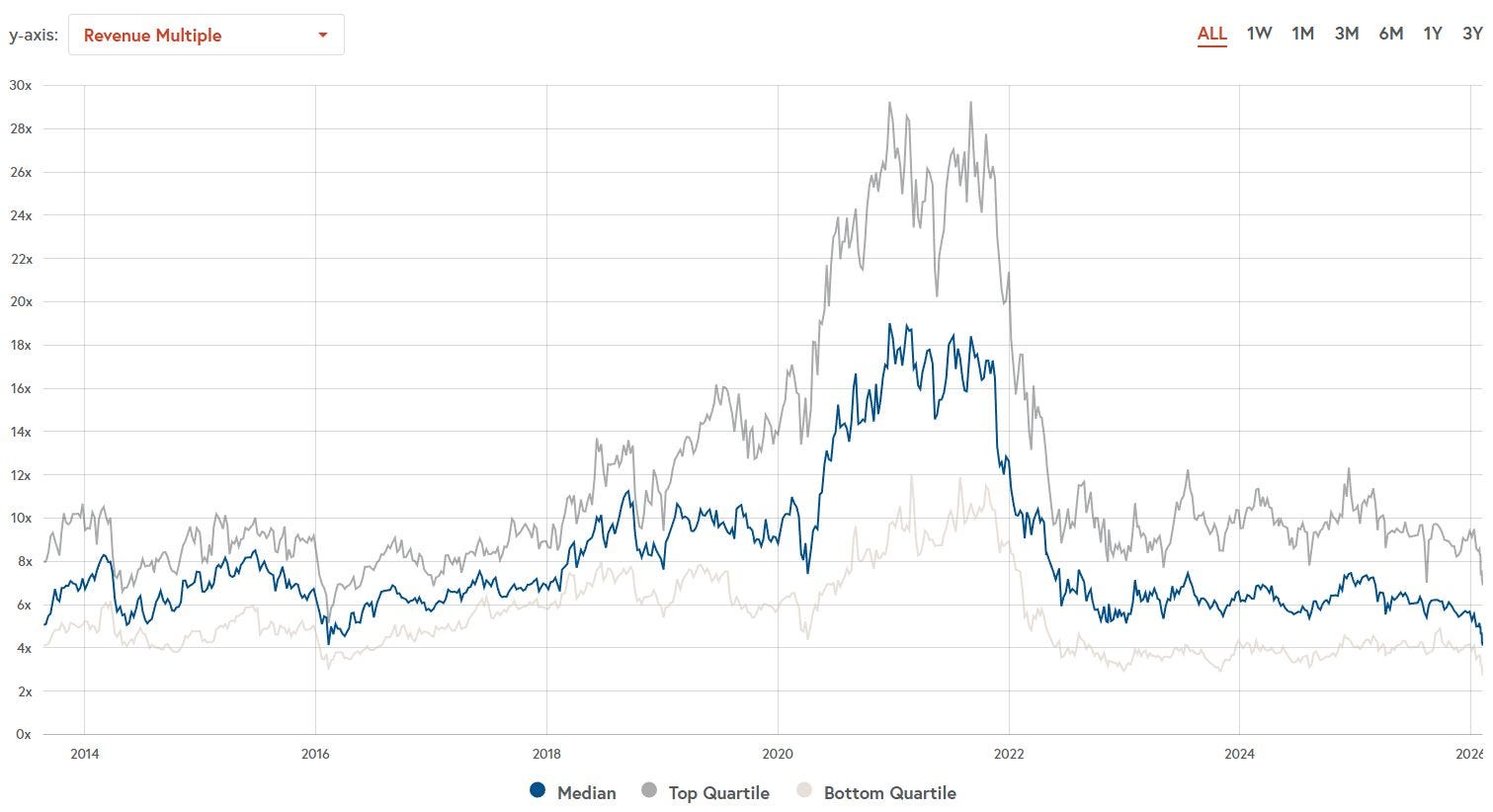
Drops like this are common in the crypto world, but you rarely it with big names like these. There is a lot of skepticism about the business model, given the rise in interest rates, delinquencies and high exposure to Software companies that have seen their multiples compress dramatically.
This prompts the question: Are we in a private credit bubble?
Keep reading to find out!
If this week’s article does not interest you, please check out some other recent ones:


What’s the Hype With Private Credit?
There isn’t a consensus of what is considered private credit, but if you take the most broad definition, that would be any credit investment that doesn’t trade on a public bond market. That would make the private credit asset class around $40 trillion, but naturally that involves a considerable amount of lending from banks.
What people really mean when they talk about private credit, is the $2-3 trillion dollars of loans, made by non-bank lenders. Much of it is considered sub-investment grade, which carries higher perceived risk but also a higher yield.
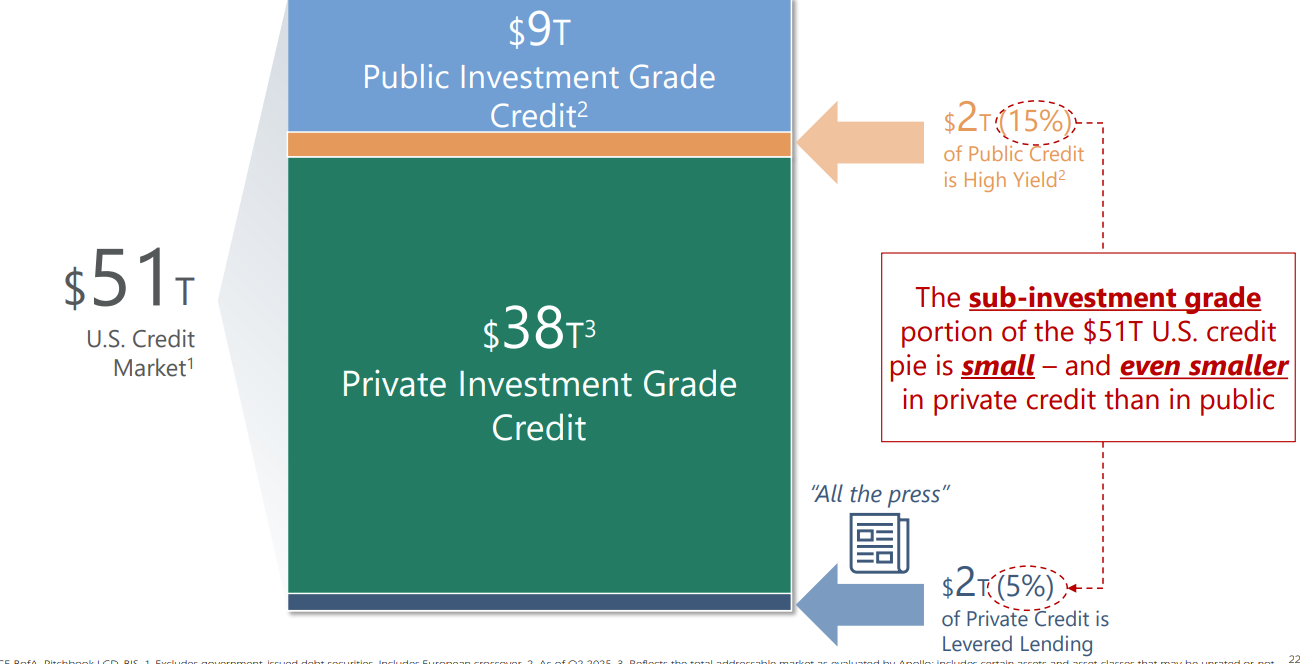
The post GFC regulations aimed to make the banking sector more secure, which they did by requiring higher levels of liquidity, reducing banks capacity to lend, especially to riskier borrowers. This created a void that private markets filled.
Most would consider this to be a positive development. Banks lend using customer deposits as their capital base, whereas investors use contributed investment capital. Would you rather a bank take losses on deposits or investment firms lose money for their fund? Almost everyone would say, tough luck for the investors. The few that don’t are those investors and maybe their fund manager.
The GFC bailouts were unpopular but they were deemed necessary, because Bernanke and others, convinced congress the broader economy would implode if banks didn’t receive those funds. The justification were big banks were considered Systemically Important Banks/Financial Institutions (SIB/SIFIs). Other banks and financial actors have since been permitted to fail, because they did not reach this bar.

Regulators didn’t need to pay much attention to private credit because they had not risen to the level of a SIFI. It was a relatively small asset class, holding mostly institutional money which are well diversified and able to sustain losses. That was true then, but now that this asset class is in the trillions, and retail investors are involved it’s a different story. Retail investors can access private credit through BDCs.
A BDC is a publicly traded investment vehicle that operates like Real Estate Investment Trusts (REITs) but for private companies. Shares trade on public markets, and shareholders get dividends derived from any net interest and realized gains. Traditional private credit or private equity funds operate differently. They are closed-end partnerships where investors commit capital for a fixed period, often 10+ years and face more restrictions if they want to redeem early.
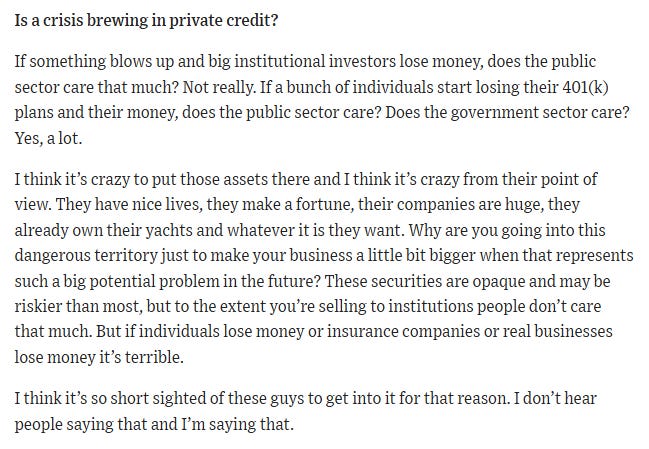
(Lloyd Blankfein, former Goldman Sachs CEO)
This distinction is important because close end funds get marked quarterly, whereas BDC share prices can be observed daily. When sentiment turns bearish, you can see it in the share price. This is why the attention is focused on BDCs even if they are only a subset of private credit, (~$500B). Their share prices are taking a beating giving investors cause for concern about the entire asset class.
First Brands Group & Blue Owl
First Brands Group, a private equity backed automotive aftermarket parts company, was financed with many tranches of debt, including from BDCs. They filed for bankruptcy in September. It had billions in outstanding loans, and its collapse, put a lot of selling pressure on BDCs.
The actual exposure of BDCs to First Brands was minor. These loans are syndicated across many firms. Even if they got zero from their First Brands positions, this likely only represented max 1-2% of net asset value (NAV) per lender. The BDC share selloff was driven more by fear and uncertainty about the business model.
Investors have concerns that private credit is highly exposed to middle market private equity backed companies that were financed when interest rates and delinquencies were low. Many of these loans were to SaaS companies that have seen their multiples compress to decade lows. Meanwhile, there are broad market concerns around what AI will do to these type of companies .
Markets are going risk off, and they’ve decided private credit is riskier than GPs claim. Big names in the space, such as Blue Owl, Apollo, Ares, Blackstone and others are down more than 30% since the start of the year.
Blue Owl in particular is drawing scrutiny because unlike these other firms, they aren’t active in private equity and other asset classes. They are effectively a pure play private credit with heavy exposure to BDCs and retail investors. The selling pressure prompted them to limit retail investor redemptions, then sell off ~$1.4 billion in assets to return capital to investors and pay down debt.
Halting redemptions is rarely a positive sign. It worked out for Michael Burry in The Big Short but usually it’s more like Bear Stearns. Their collapse began with trouble in a few of their hedge funds heavily exposed to mortgage bonds. These losses shouldn’t have been problematic but the perception of Bear’s pending insolvency caused a rush of redemptions, ultimately making it so.
With more than $800 billion dollars worth of software equity value evaporating in the last three weeks, that’s a lot of lost collateral. Already stretched companies will need to inject more capital, restructure or default. There’s allegedly hundreds of billions in dry powder available, but will GPs want to throw it at failing companies?
Default rates are already creeping up. Ratings agency Fitch reports US Private Credit Default Rates reached 5.8% in January. This is the highest they’ve seen since they began tracking this in August 2024.
Blue Owl and the other GPs are trying to relieve concerns, but the markets aren’t buying it right now. Is this just a temporary sell off or can this be indicative of a bigger problem for the asset class?
Is it a Bubble?
A bubble is when too much money chases too few assets.
Is there too much money and/or too few assets in private credit? Since 2008 we’ve been living in one of the most expansive monetary regime in history.
The M2 money supply in 2008 was $7.7 trillion. Today it’s north of $22 trillion. The US money supply has historically grown 5-7% annually. It grew >20% from 2020-2021 alone in response to COVID.
This stimulus was felt across asset classes. The stock market reached record highs, crypto was soaring. Private equity, venture capital, infrastructure all saw major inflows. Private credit was also a beneficiary; AUM more than doubled since 2019.
A lot of money entered the system in a short time frame, but it’s not a bubble if there are still good assets to invest in. Are there enough good companies to invest in?
There are more large private companies than ever: 90% of American companies with $100M+ revenue are privately held. There’s half as many publicly traded companies as there were in 1996. Private equity as an asset class has AUM in excess of $10 trillion. There are no shortage of companies to lend to.
This is definitely the pitch private credit GPs are making, but why are so many big companies staying private? Private equity has a distribution problem. The gap between realized and unrealized returns for vintages approaching 10 years keeps growing. They can only recycle investments across funds so many times.
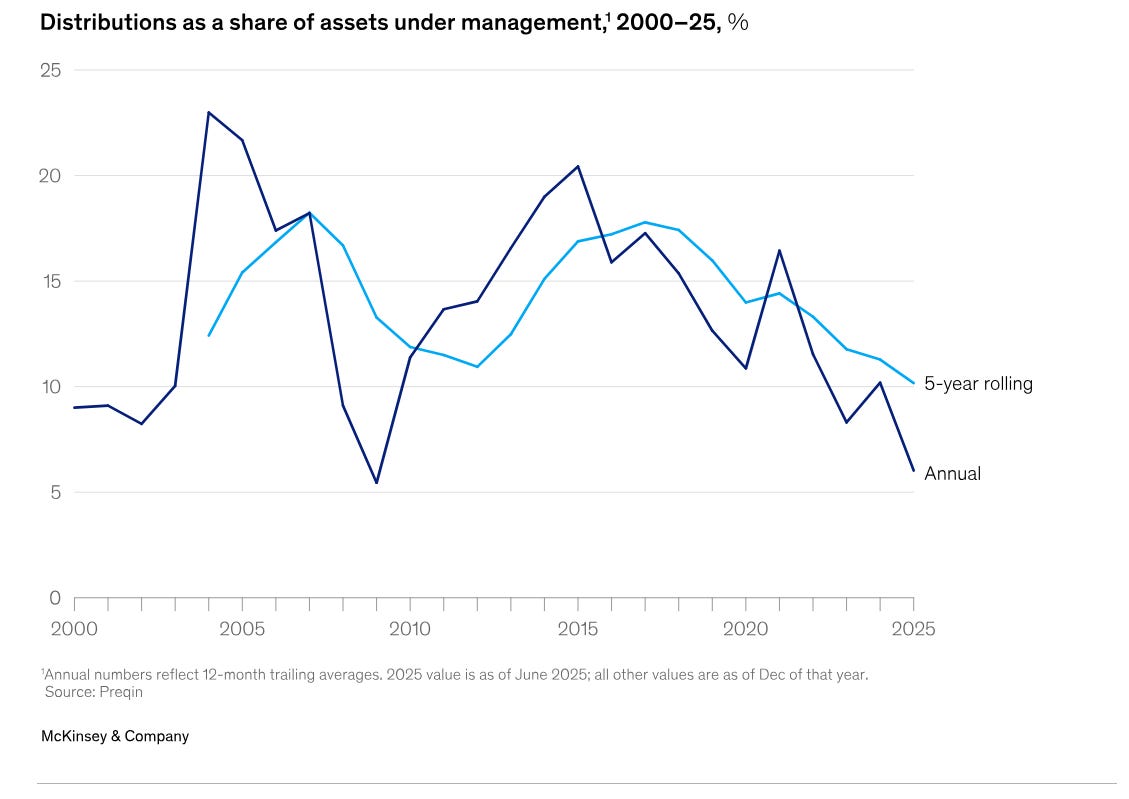
PE firms acquired companies at high multiples, the market currently isn’t paying. If they didn’t feel like they could IPO in 2021 and 2022 during the height of the ZIRP era, what market can they go public in?
Many of the loans were taken out when rates were zero. They aren’t anymore. Some of this debt is fixed and will need to be re-financed, if it hasn’t already and the other part is floating. Companies try to avoid paying higher interest, by restructuring or pushing out payments with Payment In Kind (PIK) loans. Some estimates claim more than half of these private credit loans, contain some sort of PIK conversion. This is good for the borrower, less good for the lender unless the alternative is the borrower defaults. Investors don’t want that, because then they must write down asset values. Lower assets values, means lower returns, management fees and carried interest.
GPs need to constantly raise new funds. If not, the firm will close when their last fund winds down. GPs will do anything to avoid that. They need to always find new investors, which is why firms such as Blue Owl courted retail investors.
The idea of major GPs taking retail capital 5-6 years ago, was considered unthinkable. Top funds were oversubscribed from institutional investors, and each fund got successively bigger. Seemingly too big. This is why suddenly across all private markets, there’s increasingly a push to get retail involved. They wouldn’t be doing this if they had sufficient institutional interest. Considering they haven’t yet returned the previous capital these LPs have given them, they’ve had no choice but to pursue these new investors.
It’s much tougher to raise a new fund if you aren’t one of the top performers. GP are resorting to desperate measures. Stonepeak CEO and chairman Dorrell pledged 50% of his unrealized carry to boost his funds returns. This is not common.
It’s more likely than not that private credit is in a bubble. They aren’t alone though. You can say the same for private equity and most other asset classes. The difference is, that private market firms can ride out these losses, provided they can keep raising successive funds. The Blackstones, Oak Tree’s and Apollo’s will be fine, many of the smaller names can’t survive a bad vintage.
Now that private credit is systemically important, you know that regulators, hedge funds and other market participants will pay much more attention searching for signs this could be a repeat of 2008.
Thank you for reading. If you liked this article please Subscribe below. I publish articles on a wide range of topics from business, books, current events or anything on my mind.
Note to readers: I began writing a more in depth primer on Private Credit then I came across this series of articles by junkbondinvestor and promptly accepted I couldn’t do better. They go very in-depth for people who want to dig in further. You should also see Private Credit is Lying to You & Private Credit’s Slow-Motion Reckoning by Strategist & Les Barclays
The retail money angle through BDCs is an interesting piece of the story. Most people think of private credit as purely institutional, so watching how that dynamic plays out with everyday investors adds another layer.